
Restaurant Cyber Liability: Shielding Your Digital Dining Experience
Restaurants today face a digital reality that most owners never anticipated. Hackers target payment systems, customer databases, and point-of-sale networks with increasing sophistication, and the financial and reputational damage can be devastating.
At ISU Insurance Solutions Group, we’ve seen firsthand how restaurant cyber liability insurance becomes the difference between a business that recovers and one that doesn’t. This guide walks you through the real threats your restaurant faces and how to protect it.
Why Your Restaurant Is a Cyber Target
IBM’s global Cost of a Data Breach Report 2025 provides up-to-date insights into cybersecurity threats and their financial impacts on organizations, which means your POS system handles enormous volumes of customer financial data every single day. This concentration of payment information makes restaurants extraordinarily attractive to attackers. Hackers know that most restaurants still rely on outdated security practices and that staff turnover in the industry runs high, creating gaps that are easy to exploit. The average cost of a cyberattack on a restaurant reaches about 3.3 million dollars, according to the California Restaurant Mutual Group, yet many operators still treat cybersecurity as an afterthought rather than a core business risk.
Payment Systems as Prime Targets
Ransomware attacks have become especially common in the food sector-one incident temporarily closed nearly 300 UK restaurants for a day-and phishing remains the primary entry point, with attackers targeting employee email accounts to gain access to critical systems. Smaller restaurant operators face particular vulnerability because they typically lack the resources and sophisticated security tools that larger chains can afford, leaving them exposed to threats that grow more sophisticated each year.
When customers swipe cards or tap mobile payments at your counter, their cardholder data enters your network and becomes a permanent target. Tokenization and encryption are standard defenses, yet many restaurants store raw card data or fail to keep payment processing on a separate network from guest WiFi and business systems. This creates unnecessary exposure-if a breach occurs, stolen card numbers directly fuel identity theft and fraud.
The Compliance and Vendor Risk Gap
The PCI Security Standards Council requires PCI DSS compliance for any business handling cardholder data, but enforcement gaps mean restaurants often operate without proper controls. Vendors and payment processors vary widely in their security standards, and many restaurant owners never verify that their suppliers actually encrypt sensitive information or maintain incident response capabilities. This vendor risk (often overlooked by smaller operators) can expose your entire network if a third-party processor suffers a breach.
Why Ransomware Targets Restaurants Specifically
Ransomware attacks rely on staff mistakes and weak access controls, both common in restaurant environments where turnover is constant and training budgets are tight. Once attackers gain credentials through phishing, they move laterally through networks to reach POS systems and operational data, then lock everything until the restaurant pays. The operational impact is severe-your kitchen can’t process orders, delivery apps go offline, and customers can’t pay. Unlike large corporations with IT teams, most restaurants have no backup systems and no playbook for manual operations during an outage. This desperation makes restaurants willing to pay ransom, which encourages attackers to target the industry repeatedly.
Understanding these vulnerabilities is the first step toward protection, but awareness alone won’t stop an attack. The financial and operational consequences of a successful breach demand more than good intentions-they demand a concrete strategy that combines security investments with the right insurance coverage.
What a Cyber Attack Actually Costs Your Restaurant
Operational Downtime Hits Hard and Fast
A cyberattack on your restaurant isn’t just a technology problem that gets fixed by Tuesday. The California Restaurant Mutual Group data shows the average cost reaches 3.3 million dollars, but that number only scratches the surface of what actually happens when ransomware locks your systems or hackers steal customer data. The first hit is operational downtime, and it’s brutal. When your POS system goes down during dinner service, you can’t process orders, split checks, or track inventory. Delivery apps disconnect from your kitchen. Cash registers become useless.
One ransomware incident struck nearly 300 UK restaurants and forced closures for an entire day, costing each location thousands in lost revenue plus the costs of notifying staff and customers. Smaller restaurants suffer disproportionately because they lack backup systems or manual workflows. Your staff doesn’t know how to run without digital ordering, and customers abandon you for competitors rather than wait while you figure out paper tickets. The IBM Cost of a Data Breach Report shows that operational downtime accounts for a significant portion of total breach costs, yet most restaurant owners have never run a tabletop exercise to see how they’d actually operate if their POS went dark during peak hours. That’s not theoretical-it’s a gap that will devastate your bottom line when it happens.
Reputational Damage and Customer Trust Erosion
Beyond the immediate revenue loss sits reputational damage and customer trust erosion. Data breaches involving 183,000 people with names, Social Security numbers, driver’s license numbers, and financial information have already occurred in restaurant environments. These incidents trigger mandatory state notification requirements, credit monitoring obligations, and class-action lawsuits. Your customers don’t care that you were the victim-they care that their identity is now exposed and they have to spend months monitoring their accounts. That loss of trust is permanent for many customers.
Regulatory Fines and Legal Liability Multiply the Damage
Regulatory fines vary by state, but operating without proper PCI DSS compliance triggers penalties on top of breach notification costs. Legal defense fees, settlement payments, and regulatory investigations add up fast. A restaurant handling cardholder data must maintain PCI DSS compliance, yet many operators still store raw card numbers instead of using tokenization, which means a breach directly exposes sensitive payment information and multiplies liability. When customers sue (and they will), your general liability insurance won’t cover it-you need dedicated cyber liability coverage to handle breach response, investigation costs, legal defense, and settlements.
This financial reality forces restaurant owners to confront a hard truth: the cost of recovery far exceeds the cost of prevention and proper insurance protection. Understanding what you actually face when an attack strikes is the foundation for building a defense strategy that protects both your operations and your financial stability.
What Cyber Liability Insurance Actually Covers
Cyber liability insurance fills the gap that your general liability policy leaves wide open. When a data breach hits your restaurant, you face three categories of costs that standard business coverage simply won’t touch: the immediate expense of notifying affected customers and providing credit monitoring services, the revenue you lose when systems go down, and the legal fees that pile up as you defend against lawsuits. The average monthly premium for cyber insurance in food and beverage businesses runs about $129, making it one of the most cost-effective protections available when you consider that the average cyberattack costs $3.3 million.
First-Party Coverage Protects Your Direct Losses
First-party cyber liability coverage protects your own business directly. It covers notification costs when you must contact customers whose data was exposed, credit monitoring services you must provide to affected individuals, data breach investigation expenses, and business interruption losses when an attack disrupts your operations. State data breach notification laws require disclosure within 30 calendar days of discovery, and your cyber policy handles those compliance costs automatically.
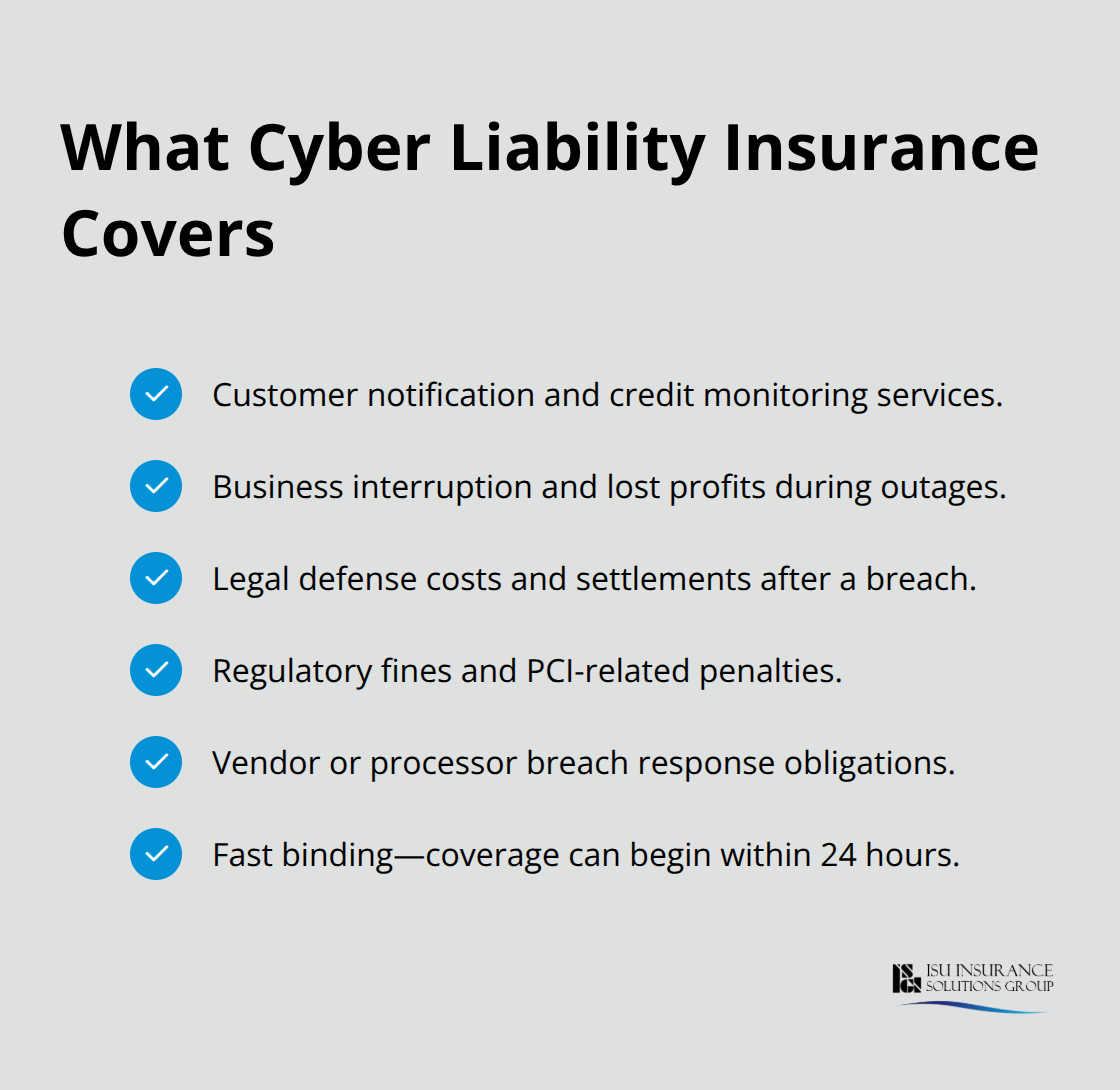
If ransomware locks your POS system during dinner service and you lose revenue for days, business interruption coverage pays for those lost profits while your team works to restore operations. Many restaurants underestimate this protection because they assume they’ll simply pay the ransom and move on, but ransomware incidents typically cost far more than the ransom demand itself when you factor in system restoration, forensic investigation, and operational downtime.
Third-Party Liability and Legal Defense Coverage
The second protection layer covers third-party liability and legal defense. When customers file class-action lawsuits after a data breach exposes their personal information, your cyber policy pays for legal defense costs and settlements, which can easily exceed hundreds of thousands of dollars. A breach affecting 183,000 people with names, Social Security numbers, and financial data triggered exactly this scenario in the restaurant industry, and without dedicated cyber coverage, the restaurant absorbed those legal costs directly. Your cyber policy also covers regulatory fines and penalties related to PCI DSS non-compliance or state data protection violations, which means you’re protected if regulators determine you failed to maintain proper security standards.
Vendor Breach Protection
Third-party liability coverage extends to situations where your vendor or payment processor suffers a breach that exposes your customer data-your policy covers your notification obligations and customer remediation costs even though the breach occurred outside your direct control. Most restaurant owners operate without understanding that their current policies exclude cyber incidents entirely, leaving them personally liable for breach response costs, legal defense, and settlements.
Getting Coverage in Place Quickly
Premium costs vary based on factors including your restaurant type, annual revenue, number of employees, and your current security practices, but restaurants that implement basic protections like staff phishing-awareness training and strong access controls often qualify for lower rates. You can obtain cyber quotes online and typically start coverage within 24 hours after your application completes, which means protection is available immediately rather than months away.
Final Thoughts
Your restaurant’s digital operations depend on two equally important strategies working together. Implement concrete security measures that reduce your attack surface: staff training on phishing and password hygiene, separate networks for payment processing and guest WiFi, tokenization of cardholder data, and regular vendor security assessments. These steps lower your risk significantly and often qualify you for better insurance rates. Secure restaurant cyber liability coverage that protects you when prevention fails, because even the best security practices cannot stop every attack.
The reality is that ransomware, data breaches, and operational outages will continue targeting restaurants. Your POS systems handle millions in customer transactions annually, your staff turnover creates security gaps, and attackers know most restaurants operate with outdated defenses. A single breach can cost $3.3 million in direct expenses, lost revenue, legal fees, and regulatory penalties. Restaurant cyber liability insurance is not optional-it is the financial safety net that keeps your business operational when an attack strikes.
At ISU Insurance Solutions Group, we work with restaurant owners throughout Washington and Oregon to build comprehensive coverage that addresses both cyber threats and traditional business risks. Our independent agency partners with multiple carriers to find you the right protection at competitive rates, and our local agents understand the specific vulnerabilities restaurants face in the Pacific Northwest. Contact us for a quote-coverage can begin within 24 hours, and the protection is immediate.
The information provided in this blog is for general informational purposes only and does not constitute legal, financial, or insurance advice. Coverage options, terms, and availability may vary. Please consult with a licensed professional for advice specific to your situation.