

Consultant Professional Liability Insurance: A Practical Risk Guide
Consultants face a unique liability exposure that general business insurance simply doesn’t cover. A single missed deadline, flawed recommendation, or contract dispute can trigger claims that cost tens of thousands to defend-even if you’re ultimately found not liable.
At ISU Insurance Solutions Group, we’ve seen too many consultants operate without proper professional liability insurance, only to face financial devastation when a client sues. This guide walks you through the real risks consultants encounter and the coverage elements that actually protect your practice.
What Consultants Actually Face in Liability Claims
The Three Claim Types That Hit Hardest
Negligence allegations, misrepresentation, and breach of contract form the core liability exposure for consultants. A strategy consultant who recommends a market expansion that tanks costs the client millions in losses. An IT consultant who implements a system that fails to meet promised performance metrics triggers a lawsuit. A business coach whose advice leads to poor hiring decisions results in client losses that balloon into six-figure claims. These scenarios happen constantly across the consulting industry.
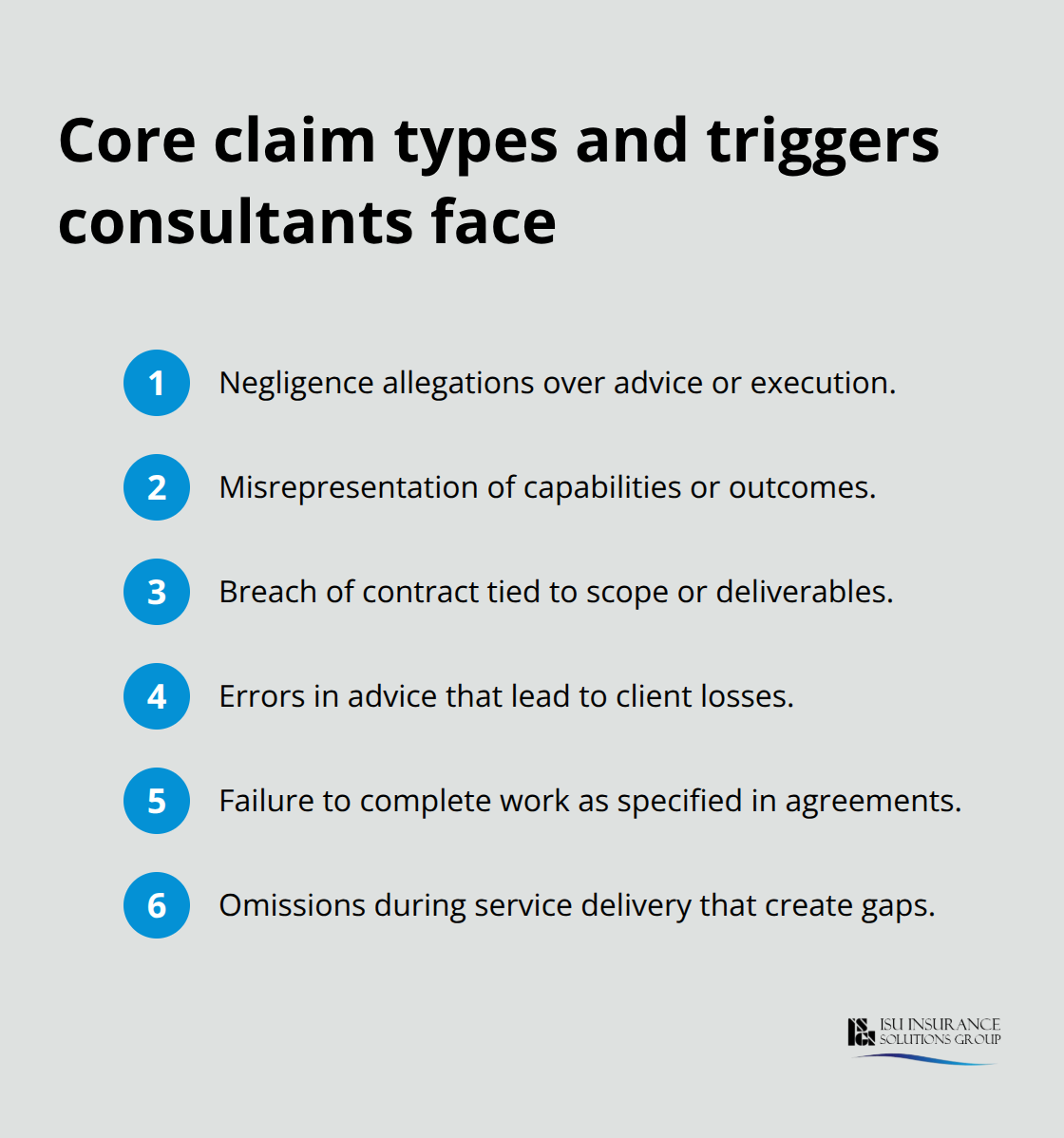
The Hartford reports that common claim triggers include errors in advice, failure to complete work as specified, and omissions in service delivery.
Why defense costs alone devastate uninsured consultants
Legal fees for a professional liability dispute typically run $50,000 to $150,000 before any settlement or judgment is paid. If you’re uninsured, that money comes directly from your business bank account or personal assets. Over a five-year period, the overall average professional liability claim was $20.1 million, with a maximum settlement exceeding $500 million. Most consultants operate without realizing their general liability policy won’t touch these claims. General liability covers bodily injury or property damage-someone slips in your office or you accidentally damage client equipment. It doesn’t cover the core risk of consulting: that your advice or work product caused financial harm.
The Coverage Gap in Standard Business Policies
Your homeowners or business owners policy has the same blind spot. A client suing you for negligent advice falls entirely outside standard coverage. This is the gap that professional liability insurance fills. Without it, you’re personally liable for every dollar of damages and defense costs. With a $1 million policy, your insurer covers legal defense from day one, handles settlement negotiations, and pays judgments up to your limit. The policy also protects your cash flow during litigation-critical for solo consultants or small firms where legal costs can force closure.
Claims-Made Coverage and the Tail Coverage Trap
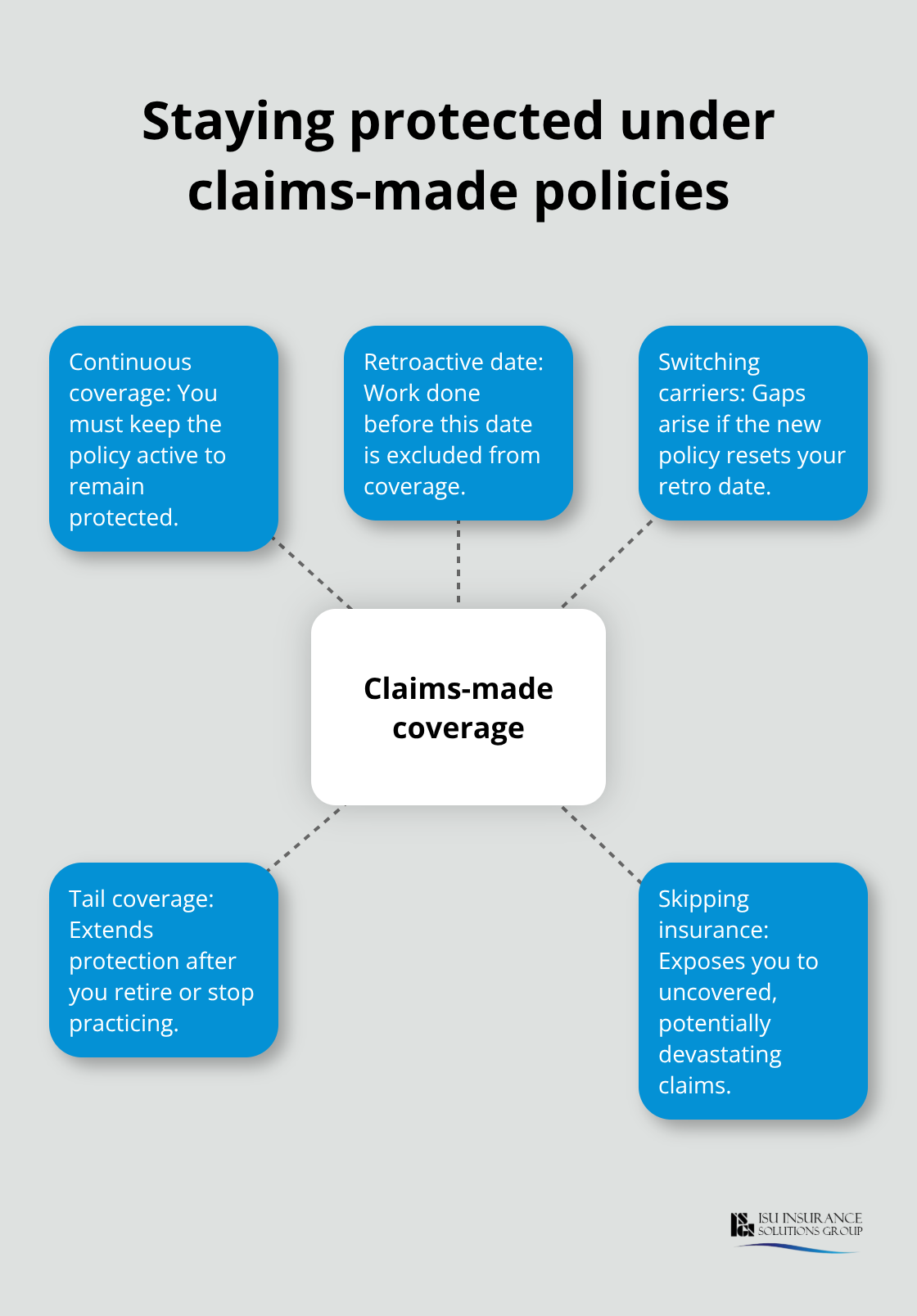
The claims-made structure most carriers use means you need continuous coverage to stay protected. If you cancel your policy or switch carriers, claims filed after your policy ends for work you did years earlier fall outside coverage. That’s why tail coverage exists-to protect you after you leave the profession or retire. Skipping professional liability insurance isn’t a cost-saving decision.
It’s a bet that no client will ever sue you, and that bet has odds worse than most consultants realize.
Now that you understand the financial and operational risks, the next section examines real-world scenarios where professional liability coverage actually protects consultants-and shows how quickly claims escalate when coverage is absent.
Real-World Scenarios Where Professional Liability Coverage Protects Consultants
When Project Delays Trigger Financial Claims
A management consultant recommends a restructuring plan that costs the client $400,000 in severance and lost productivity when the reorganization fails to deliver promised efficiency gains. The client sues for negligent advice. Without professional liability insurance, the consultant faces $75,000 in legal defense costs before any settlement discussion begins. With coverage, the insurer’s legal team handles the defense immediately, investigates the claim, and negotiates a resolution while the consultant continues working. This difference between insured and uninsured outcomes determines whether a single claim ends a consulting practice or becomes a manageable business expense.
Project failures and missed deadlines generate claims when clients tie delays to specific financial losses. An HR consultant hired to implement a new payroll system misses the go-live date by three months, forcing the client to extend a temporary staffing contract at premium rates and incur overtime costs totaling $180,000. The client claims breach of contract and negligence in project management. Even if the consultant ultimately proves the delay resulted from the client’s own scope creep, defending against this claim costs $60,000 to $100,000 in legal fees. Professional liability insurance covers these defense costs from day one and negotiates settlement if the claim has merit.
When Advice Creates Measurable Financial Harm
Advice-driven claims cut deeper because they involve subjective judgment calls. A financial consultant recommends a portfolio strategy that underperforms market expectations, and the client loses $250,000 over two years. The client alleges the consultant failed to assess risk tolerance accurately or recommend appropriate diversification. The claim hinges on whether the advice was negligent or simply unsuccessful-a distinction that requires expert testimony and detailed documentation to defend. Defense costs often exceed $100,000 for these cases because they demand financial experts and depositions. Without insurance, the consultant absorbs these costs while simultaneously managing the emotional and professional strain of litigation.
When Contract Disputes Escalate Into Lawsuits
Contractual disputes emerge when clients interpret service scope differently than the consultant does. A technology consultant delivers a system that works as specified in the statement of work but doesn’t solve the business problem the client expected it to solve. The client claims the consultant misrepresented the system’s capabilities and demands a refund plus damages for lost productivity. The dispute centers on what was promised versus what was delivered, and defending your interpretation of the contract requires legal representation, potentially expert witnesses, and months of document review.
How Coverage Transforms Claims Into Managed Expenses
These three scenarios happen to consultants across industries every single year. Professional liability insurance transforms them from existential threats into covered claims that your insurer manages. The next section examines the specific coverage elements that actually protect you-and which policy features separate adequate protection from inadequate coverage that leaves gaps when you need it most.
What Professional Liability Policies Actually Cover
The gap between what you think your policy covers and what it actually covers costs consultants thousands in out-of-pocket expenses every year. Three specific policy elements determine whether you’re genuinely protected or facing financial exposure when a claim arrives: the retroactive date, how defense costs are handled, and your aggregate versus per-claim limits. Understanding these components means the difference between a claim that your insurer manages and a claim that drains your business reserves.
The retroactive date determines what work is actually covered
Your retroactive date is the starting point for coverage on a claims-made policy. Any work you performed before that date falls outside coverage, even if the client sues years later. This creates a critical vulnerability when you renew your policy or switch carriers. If you cancel coverage and restart with a new policy, the new retroactive date abandons all prior work to future claims. A consultant who worked with a client in 2023, cancelled coverage in 2025, and faced a lawsuit in 2026 for that 2023 engagement finds the claim completely uncovered because the new policy’s retroactive date is 2025.
This is why continuous coverage matters and why tail coverage exists. When you leave consulting or retire, tail coverage extends protection backward to cover claims filed after your policy ends for work you completed during your active years. The cost of tail coverage typically runs 150 to 300 percent of your annual premium, depending on your policy limits and claims history. That expense feels painful until you face a claim from a decade-old engagement and realize tail coverage saved your retirement savings. Keep the same retroactive date across every renewal to eliminate gaps. If you absolutely must switch carriers, negotiate to maintain your original retroactive date with the new insurer or purchase tail coverage immediately to protect the gap period.
Defense costs determine whether litigation destroys your cash flow
Two policy structures exist for defense costs, and the difference is substantial. Some policies cover defense costs as part of your aggregate limit, meaning every dollar spent on lawyers reduces what’s available for settlements or judgments. A $1 million policy with defense costs eating into the limit might leave only $700,000 for actual damages after legal fees consume $300,000. Other policies provide defense costs separately outside the aggregate limit, meaning your full $1 million remains available for damages while the insurer covers legal expenses on top.
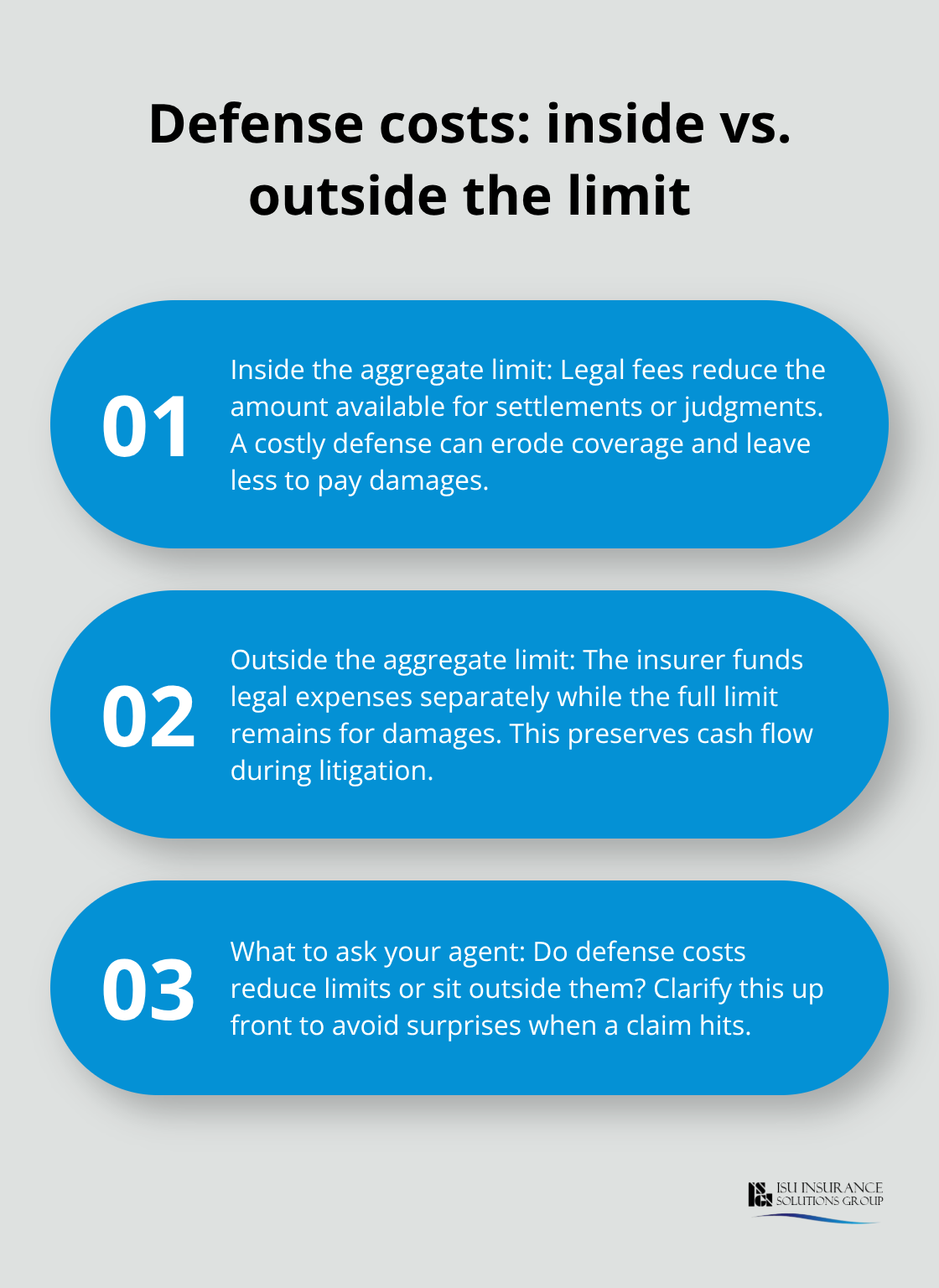
Separate defense cost coverage is vastly superior because it protects your cash flow during litigation without depleting your damage coverage. When shopping for quotes, ask explicitly whether defense costs reduce your limits or sit outside them. This single question separates adequate policies from inadequate ones. For consultants, separate defense cost coverage isn’t a luxury-it’s foundational protection that keeps your business operating while claims are resolved.
Aggregate limits versus per-claim limits shape your true exposure
Your aggregate limit is the maximum your policy pays across all claims in a single year. Your per-claim limit is what you recover per individual claim. A $1 million aggregate with $500,000 per-claim means you’re covered for two claims at $500,000 each, but a third claim in the same year gets zero coverage. Many consultants buy $1 million policies assuming they’re fully protected, then discover the aggregate covers only one substantial claim before the policy is exhausted.
Multiple claims in one year aren’t rare-they happen when dissatisfied clients compare notes or when a single consulting engagement triggers disputes with multiple stakeholders. Severe claims can reach substantial amounts depending on industry and engagement size. If your consulting work touches finance, healthcare, or technology sectors, claims skew larger because client losses are quantifiable and substantial. Try sizing your aggregate limit to handle at least two significant claims in a single year, not just one. For most consultants, a $2 million aggregate with $1 million per-claim provides realistic protection without overbuying coverage you’ll never use.
Final Thoughts
Professional liability insurance isn’t optional for consultants in 2026. The financial stakes are too high, the claim frequency too real, and the coverage gaps in standard business policies too wide. A single lawsuit over negligent advice, missed deadlines, or contractual disputes costs $50,000 to $150,000 in legal defense alone, and without consultant professional liability insurance, that money comes directly from your business reserves or personal assets.
Start by auditing your current policies and pulling out your general liability declarations to confirm what’s actually covered. Call your agent and ask whether defense costs reduce your aggregate limit or sit outside it, then verify your retroactive date and whether you have tail coverage protection if you ever leave the profession. Most consultants discover gaps in this review that surprise them, and sizing your aggregate limit to cover at least two significant claims in a single year (not just one) provides realistic protection without overbuying.
At ISU Insurance Solutions Group, we’ve worked with consultants across Washington and Oregon since 1983 to build coverage that matches your actual risk profile. Contact us today to evaluate your current protection and explore options that fit your practice, because the difference between adequate coverage and inadequate coverage often emerges only when a claim arrives.
The information provided in this blog is for general informational purposes only and does not constitute legal, financial, or insurance advice. Coverage options, terms, and availability may vary. Please consult with a licensed professional for advice specific to your situation.