

Restaurant Workers Comp Costs: What Affects Premiums
Restaurant workers comp costs can spike unexpectedly without the right knowledge. At ISU Insurance Solutions Group, we’ve seen firsthand how premiums vary dramatically based on payroll, claims history, and workplace hazards.
The good news is that most premium increases are preventable. This guide walks you through exactly what drives your costs and how to bring them down.
The Three Numbers That Control Your Restaurant’s Workers Comp Bill
Payroll: The Foundation of Your Premium
Your workers comp premium starts with payroll-the total wages you pay your staff. Insurers multiply your payroll by a rate per $100, and this rate varies by job classification. A cook in Washington state carries a different rate than a dishwasher or server because the classification reflects injury risk. Misclassifying staff to lower premiums backfires; audits catch it, and you’ll owe back premiums plus penalties. Many restaurant owners underestimate their true payroll, which triggers surprise bills during renewal. Accurate classification matters more than most owners realize because a single misclassified employee across multiple locations compounds the problem quickly.
Claims History: Your Experience Modification Rate
Your claims history shapes your premium through an Experience Modification Rate, or EMR. This number compares your actual losses to expected losses for similar businesses. An EMR of 1.0 means you’re average; above 1.0 and your premium climbs; below 1.0 and you receive a discount. One serious burn injury or back claim pushes your EMR up for three to five years, which means a single bad year creates lasting cost damage. This extended impact is why loss prevention matters so much-you carry the financial weight of claims far longer than most owners expect.
Operational Hazards: The Nature of Your Work
The third factor is the nature of work itself-the hazards inherent to your operation. Kitchens involve heat, sharp objects, and repetitive motion. Dining areas create slip-and-fall exposure. These hazards determine your base rate before any adjustments. A fast-casual concept with limited kitchen work qualifies for lower rates than a full-service restaurant with extensive prep. Insurers also examine your specific operations: Do you use open flames? Do you have grease traps that create slipping hazards?

Do you operate late-night shifts when fatigue increases mistakes? These operational details directly influence your premium structure, which is why two restaurants of similar size can have vastly different costs. Understanding what insurers measure in your kitchen and dining areas helps you identify where premium reductions actually happen.
Where Restaurant Staffing Problems Hit Your Insurance Bill
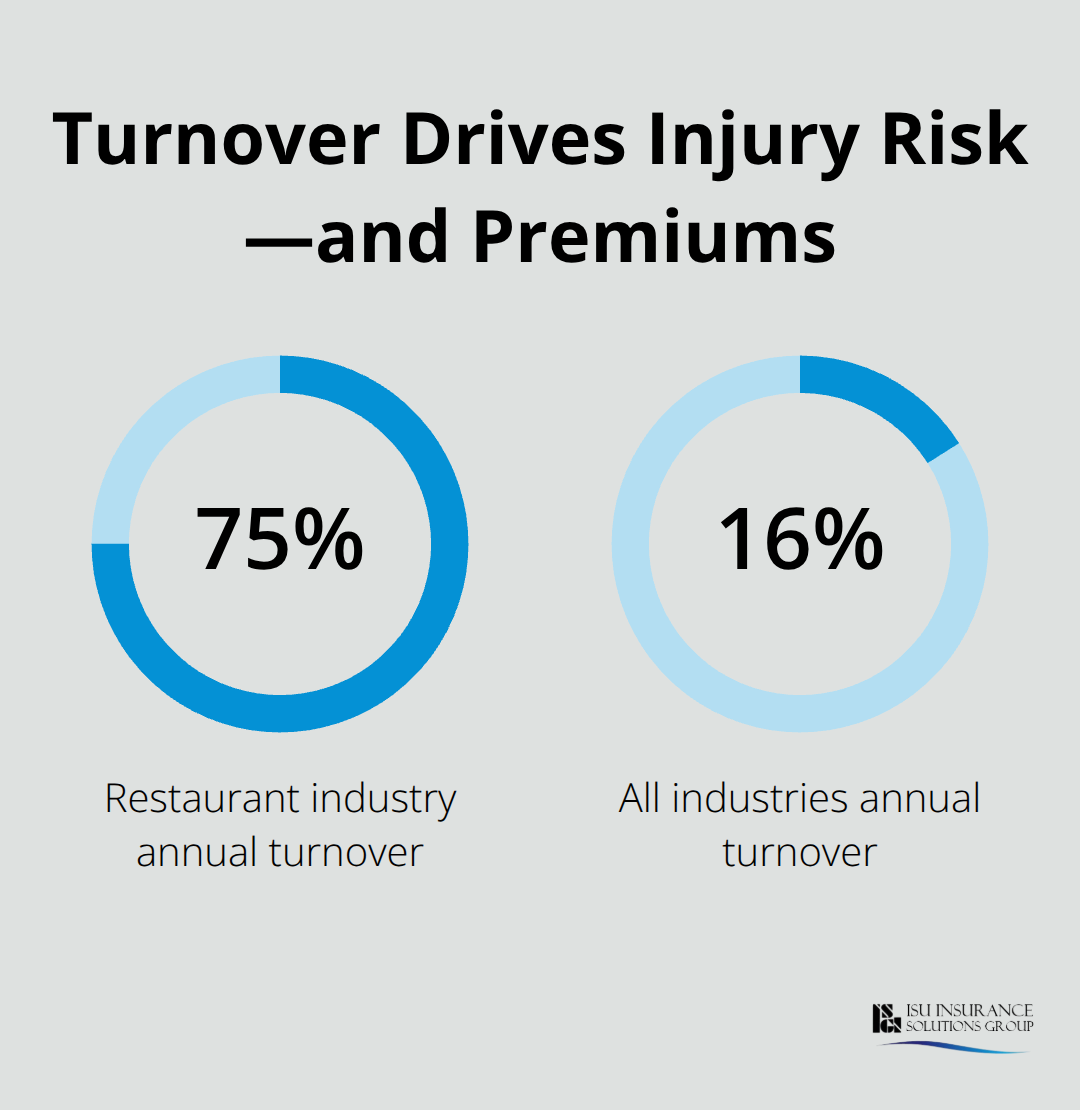
Restaurant staffing instability directly inflates your workers comp costs in ways most owners overlook. The National Restaurant Association reports that the industry experiences roughly 75% annual turnover, compared to 16% across all industries. When you constantly train new staff, injury rates spike because inexperienced workers don’t yet understand kitchen hazards or proper safety protocols. Insurers know this pattern cold-they’ve watched it repeat for decades.
A kitchen with predominantly new hires carries measurably higher injury claims than one with stable, trained teams. Your Experience Modification Rate doesn’t just reflect what happened; it forecasts risk based on your workforce stability. High turnover also means inconsistent safety culture. One experienced cook might enforce proper knife handling, while a replacement hired last week hasn’t absorbed those practices yet. Insurers factor this predictability gap into your premium structure because they can quantify it through claims data.
Training Programs Lower Your Premium
Restaurants that maintain structured onboarding programs and document safety training see measurable premium reductions within 12 to 18 months. This happens because your claims history improves, which lowers your Experience Modification Rate. Consistent training protocols and lower turnover create the foundation for real savings at renewal time.
Burn Injuries Drive Serious Costs
Burns represent the most expensive per-claim injury in food service. The average workers comp claim for a serious burn injury costs between $25,000 and $75,000 when you factor in medical treatment, lost time, and potential long-term care. A single severe burn claim pushes your Experience Modification Rate upward for years, creating a permanent cost penalty that extends far beyond the initial medical bills. Insurers understand that kitchen design, equipment maintenance, and staff positioning directly influence burn frequency. Open-flame cooking, malfunctioning equipment guards, and overcrowded line stations all increase burn exposure. Your insurer may conduct a kitchen walkthrough and identify specific hazards that drive their rate decision. Restaurants operating with older equipment or poorly maintained fryers face higher premiums because the equipment itself carries elevated injury risk. Installing proper ventilation, maintaining equipment regularly, and rotating staff positions to reduce fatigue all reduce burn frequency. Documentation matters too; when you show your insurer that you’ve invested in equipment upgrades or implemented specific safety measures, it supports a request for a premium review or rate reduction.
Slip and Fall Claims Signal Management Gaps
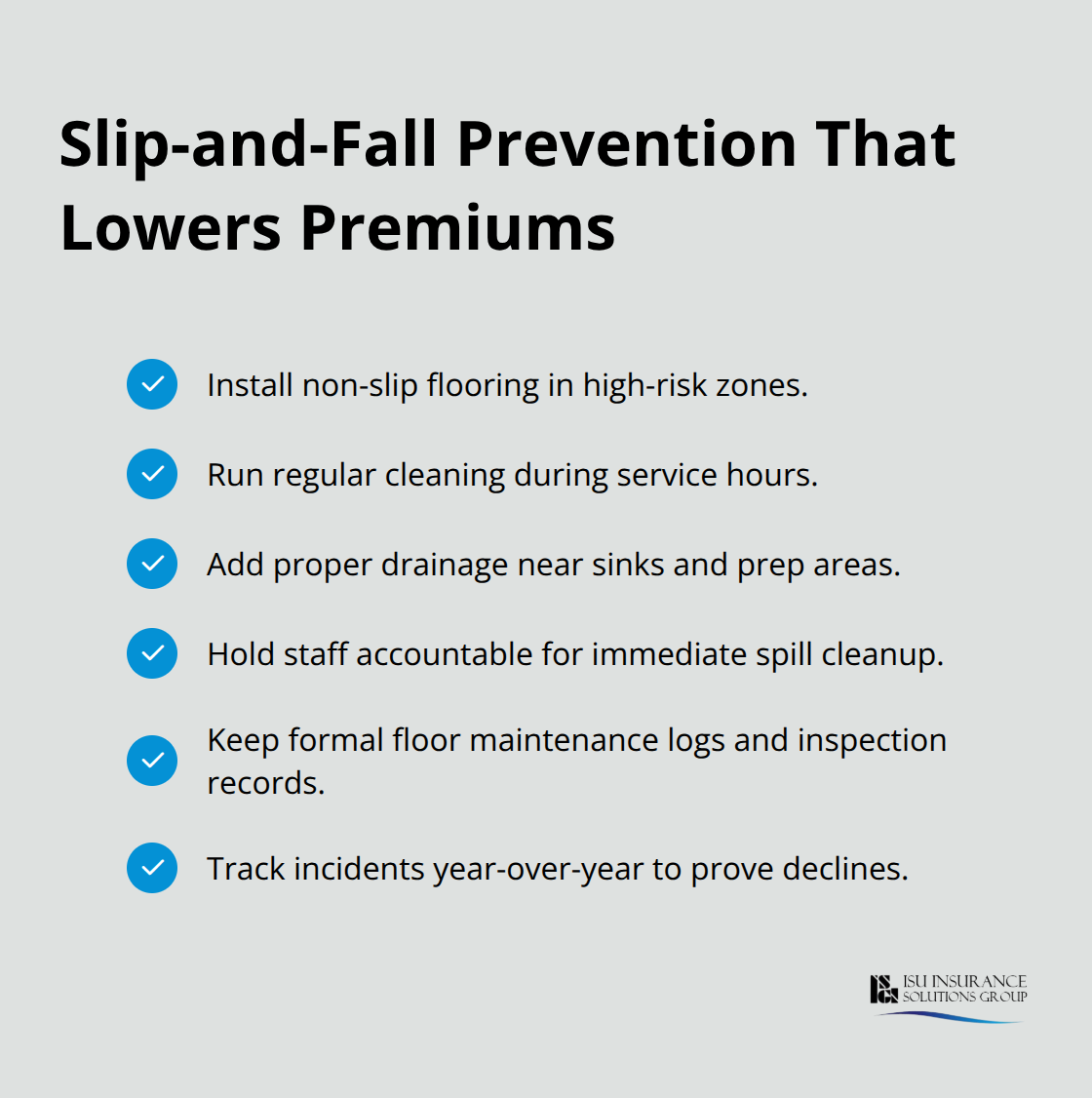
Slip and fall claims represent roughly 25% of restaurant workers comp claims, according to OSHA data. These injuries seem minor until you examine the medical costs-a serious slip causing a fractured wrist or torn ligament averages $15,000 to $40,000 in total claim costs. What makes slip and falls particularly damaging to your premium is their frequency and predictability. Insurers see slip and fall data as a direct reflection of your operational standards and maintenance protocols. Wet floors, grease buildup, poor lighting, and worn flooring create measurable hazards that insurers can identify during inspections. A restaurant with documented slip and fall incidents in the past three years signals to insurers that management isn’t controlling environmental risk-which means your premium reflects that assessment. Non-slip flooring in high-risk zones, regular cleaning protocols during service hours, proper drainage systems, and staff accountability for immediate cleanup all address this exposure. Restaurants that implement formal floor maintenance documentation and can show inspection records see lower claim frequency, which improves their Experience Modification Rate over time. Your insurer wants to see evidence that you manage these preventable hazards actively, not reactively. When you demonstrate that slip and fall incidents have declined year-over-year through specific operational changes, you’ve created the foundation for a meaningful premium reduction at your next renewal-and you’re ready to tackle the strategies that lock in those savings.
How to Cut Your Workers Comp Premium
Safety Training Programs Reduce Claims Fast
Safety training programs work because they directly reduce claim frequency, and insurers measure this reduction through your Experience Modification Rate. Start by identifying your highest-risk positions: line cooks, dishwashers, and servers account for roughly 70 percent of workers comp claims in food service. Develop role-specific training that addresses actual hazards these positions face daily. A line cook needs hands-on instruction on knife safety, burn prevention, and equipment operation, not generic restaurant safety videos.
Document everything-attendance records, training dates, competency assessments-because insurers want proof that training actually happened and stuck. When your insurer conducts a renewal inspection, this documentation becomes your evidence that you’re actively managing risk. Schedule training during slower service periods or before shifts start, not as an afterthought. Many restaurant owners skip formal training because they assume experienced staff will pass knowledge to new hires informally, but this creates the exact inconsistency that drives up premiums.
Return-to-Work Protocols Cut Claim Costs
Your training program should also include return-to-work protocols that get injured employees back into productive roles safely. Create specific roles that accommodate temporary restrictions-a cook recovering from a wrist injury might handle prep work that doesn’t require gripping, or a server with a back strain might work host duties temporarily.
This approach keeps your payroll stable, maintains employee morale, and reduces the total cost of each claim. Write these return-to-work assignments in writing and communicate them to your insurance carrier because this proactive management directly influences your Experience Modification Rate calculation at renewal.
Payroll Accuracy Prevents Costly Audits
Payroll accuracy and job classification deserve obsessive attention because a single misclassification audit can cost thousands in back premiums and penalties. Each position in your restaurant carries a specific classification code that determines the rate applied to that employee’s wages. A cook preparing food carries code 8868 in Washington state with a premium rate around 42 percent per $100 of payroll, while a server with minimal kitchen exposure might carry code 8875 at 18 percent per $100.
The difference matters enormously: a restaurant with 20 employees misclassified as servers instead of cooks could underreport premiums by $8,000 to $15,000 annually, triggering audits and penalties when discovered. Review your payroll records quarterly and compare job titles to actual duties. If someone spends 60 percent of their time cooking and 40 percent serving, they need to be classified as a cook, not a server.
Classification Changes Require Transparency
When you hire, write down the primary responsibilities for each position so there’s no ambiguity during an audit. Many insurers offer payroll audits at renewal to verify accuracy, and you want your records to withstand that scrutiny immediately. If you work with a payroll service, try to ensure they understand your restaurant’s specific classifications and don’t default everyone to a single category. Communicate with your insurance agent about any role changes or new positions before renewal, not after. This transparency prevents surprises and gives your agent the opportunity to adjust your policy proactively rather than discovering errors during an audit.
Final Thoughts
Your restaurant workers comp costs depend on three controllable factors: payroll accuracy, claims history, and operational hazards. Misclassified staff, preventable injuries, and poor safety documentation create a compounding cost problem that extends years into the future through your Experience Modification Rate. The restaurants paying the lowest premiums aren’t hoping for luck-they document training, maintain equipment, and manage payroll with precision.
Loss prevention delivers long-term financial benefits that extend far beyond a single renewal period. When you reduce slip and fall incidents through better floor maintenance or lower burn claims through equipment upgrades, you build a track record that keeps your Experience Modification Rate low for years. A restaurant that stays claim-free for three years sees measurable premium reductions at every renewal, compounding savings that add up to tens of thousands of dollars over time.
Start by auditing your current payroll classifications against actual job duties, then implement documented safety training for your highest-risk positions. Contact an insurance professional who understands restaurant operations and can review your specific exposure to identify premium reduction opportunities. Our team at ISU Insurance Solutions Group has served Washington and Oregon restaurants since 1983, and we work with multiple carriers to find coverage that matches your actual risk profile and budget.
The information provided in this blog is for general informational purposes only and does not constitute legal, financial, or insurance advice. Coverage options, terms, and availability may vary. Please consult with a licensed professional for advice specific to your situation.