

Security Guard Liability Insurance: Protect Your Team and Clients
Security guard liability insurance isn’t optional-it’s a business necessity. One lawsuit can drain your resources and damage your reputation, which is why we at ISU Insurance Solutions Group recommend understanding what this coverage actually protects.
Your team faces real risks every day, from use-of-force incidents to false arrest allegations. The right insurance shields both your business and your clients from financial devastation.
Why Liability Insurance Protects Your Bottom Line
A single lawsuit against your security firm costs between $50,000 and $500,000 in legal defense alone, depending on the claim’s complexity and jurisdiction. That’s before settlements or judgments. Most security companies operate on tight margins, and one significant liability claim wipes out years of profit or forces closure. Liability insurance absorbs these catastrophic costs so your business survives the incident. Without it, you’re betting your company’s future on never facing a lawsuit, which is unrealistic in an industry where physical confrontation and property access are daily realities.
The Real Cost of Uninsured Incidents
False arrest claims average $40,000 to $150,000 in legal fees and settlements when a guard detains someone without proper legal grounds. Excessive force incidents push costs even higher because injury claims compound quickly with medical expenses and lost wages. One Denver security firm faced a $300,000 settlement after a guard’s excessive force claim, and that’s considered moderate for the market. Property damage claims add another layer-if your team fails to secure an area and someone’s equipment gets stolen or damaged, you’re liable for replacement costs plus legal expenses. Courts rarely side with uninsured defendants because juries assume the company is hiding something. Having documented coverage signals responsibility and credibility, which actually reduces settlement amounts because plaintiffs see legitimate compensation coming.
Employment Claims Drain Resources Fast
Wrongful termination, discrimination, and harassment lawsuits from your own employees represent a separate and growing liability exposure. Colorado reported a 12% increase in employment-related security guard claims between 2023 and 2025, according to industry loss data. These cases cost $30,000 to $200,000 in legal defense even when you win because employment law requires extensive documentation review and witness testimony. One guard alleged discrimination after termination, and the company spent $85,000 defending itself before the claim was dismissed. That money vanished-no revenue, no asset protection, just legal bills. Liability coverage that includes employment practices protection prevents these internal disputes from destroying your cash flow and company culture.
Why Uninsured Operations Fail
Your team members represent your biggest operational risk, and proper insurance acknowledges that reality. Security firms without liability protection face a choice: pay settlements out of pocket or declare bankruptcy. Insurance transfers that financial burden to carriers who specialize in managing these claims. The alternative-self-insuring through cash reserves-leaves your business vulnerable to the next incident. Most security operations lack the financial depth to absorb multiple claims in a single year, which means one lawsuit can trigger a cascade of problems (missed payroll, equipment purchases delayed, client contracts lost). The firms that survive and grow are the ones that protect themselves before incidents happen, not after.
Common Liability Risks in Security Operations
Use-of-force incidents dominate liability claims in the security industry, and the numbers are brutal. Excessive force allegations cost between $100,000 and $400,000 in legal defense and settlements when a guard applies more physical contact than necessary to restrain or detain someone. Courts scrutinize these cases heavily because juries sympathize with injury victims, and medical documentation makes damages obvious and quantifiable.
When Force Crosses the Line
A guard who uses a takedown on a trespasser faces liability even if the trespasser was technically trespassing, because the force applied must match the threat level. Training your team on proportional response reduces claims, but it doesn’t eliminate them entirely-confrontational situations escalate unpredictably, and split-second decisions get reviewed in depositions months later with the benefit of hindsight. The guard’s actions in the moment feel justified, yet a courtroom analysis months later paints a different picture. Juries award damages based on injury severity and medical costs, not on the guard’s intent or reasoning.
False Arrest and Wrongful Detention
False arrest and wrongful detention claims run $75,000 to $250,000 because they combine legal defense with reputational damage and client contract losses. When a guard detains someone without legal authority-detaining a person they suspect of theft but cannot actually prove committed a crime-the detained party has grounds for a lawsuit. Colorado courts apply strict standards for detention, and security firms that lack clear written protocols for when guards can and cannot detain people face compounding liability. One missed detail in your detention procedures (not calling police fast enough, holding someone too long, not informing them they can leave) transforms a reasonable security response into a wrongful detention claim worth six figures.
Surveillance Failures and Data Breaches
Inadequate surveillance and security breaches expose your firm differently but cost just as much. When your team fails to monitor an area and someone steals client property or gets injured on premises, your firm bears liability because the contract implied active protection. A retail security operation that missed a shoplifter because cameras were broken or staff weren’t positioned correctly faces property damage claims from the retailer plus potential bodily injury claims if the shoplifter injured someone during theft.
Data breaches add another layer-if your guards collect client information and that data gets stolen through poor cybersecurity practices, you’re liable for notification costs, credit monitoring services, and lawsuits from affected individuals. Security firms increasingly handle sensitive client databases and surveillance footage, which means a single breach can trigger claims exceeding $150,000 when you factor in regulatory fines and legal response. Vague coverage areas create liability exposure because clients assume full protection when none exists.
Protecting Against Coverage Gaps
Written service agreements that specify surveillance methods, response times, and coverage limitations protect both you and your clients by establishing clear expectations. Document your surveillance capabilities in contracts so clients understand exactly which areas your guards monitor and what response times they can expect. This clarity prevents misunderstandings that transform into expensive disputes. The next section examines what liability insurance actually covers and how different policy types address these specific risks your team faces daily.
What Your Liability Policy Actually Covers
Security guard liability insurance protects three critical areas that separate surviving a lawsuit from bankruptcy. Third-party bodily injury coverage pays medical expenses, lost wages, and legal fees when your guard injures someone during duty-whether that’s a trespasser injured during a takedown, a customer harmed during a confrontation, or a bystander caught in the middle. Property damage coverage reimburses clients when your team fails to secure an area and property gets stolen or damaged on their premises. Both coverages typically start at $1 million per occurrence for small to mid-sized security operations, though high-risk contracts (retail chains, government facilities, large events) demand $2 million or higher. The policy pays defense costs separately from the coverage limit, meaning your $1 million limit stays intact while the insurance carrier covers attorney fees, expert witnesses, depositions, and court costs-that separation matters because legal defense alone consumes $50,000 to $150,000 before any settlement gets paid.
How Third-Party Coverage Protects Your Operations
Third-party bodily injury and property damage coverage form the foundation of liability protection. When your guard injures someone or your team fails to prevent property loss, this coverage activates immediately. The insurance carrier assigns defense counsel within days of notification, which stops your company from hemorrhaging cash on legal bills.
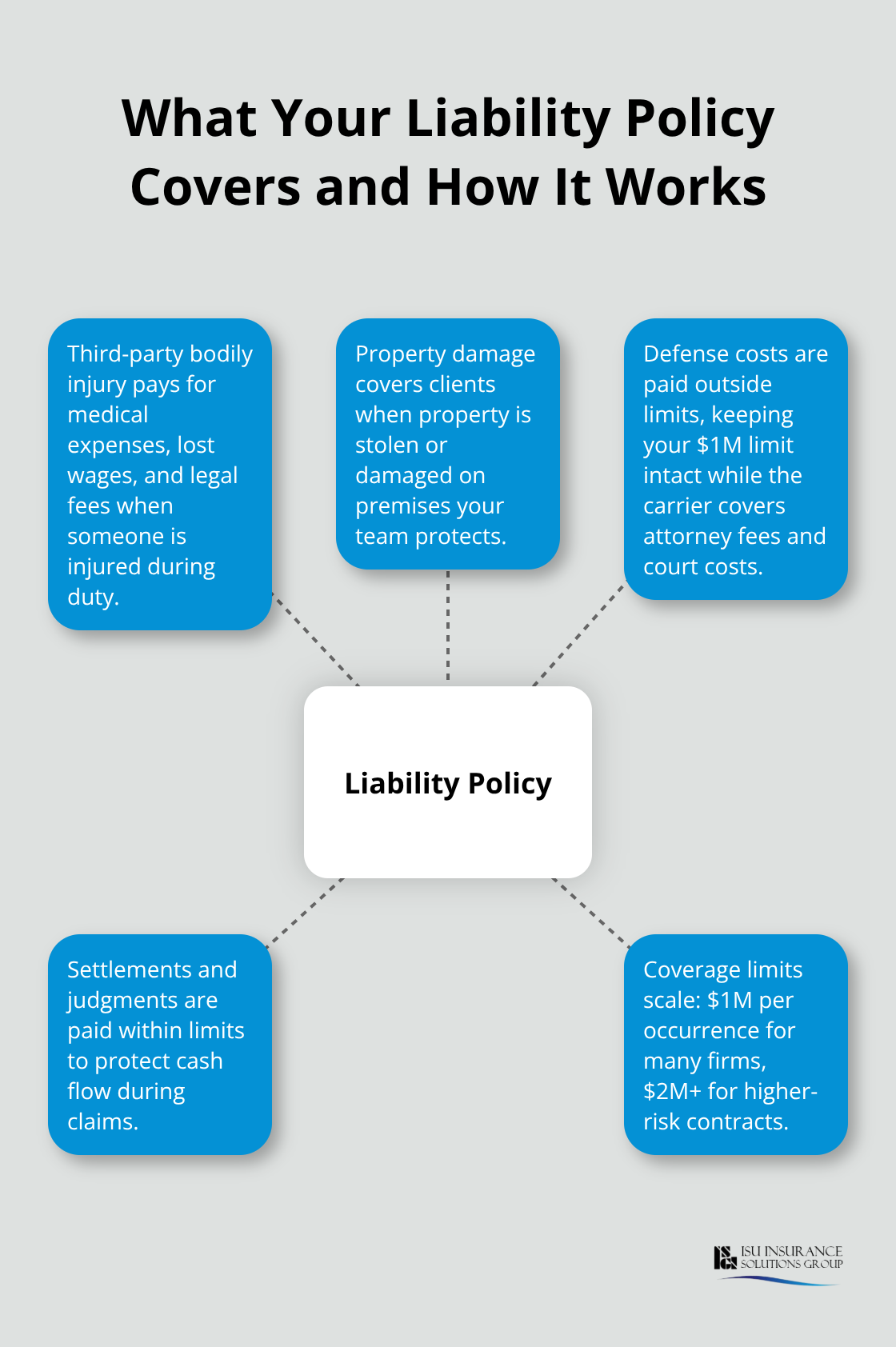
Your coverage limit remains untouched while the carrier pays attorney fees, expert witnesses, and court costs-a critical distinction because legal defense alone can reach $50,000 to $150,000 before settlement negotiations even begin.
Understanding Settlement and Judgment Protection
Settlements and judgments fall within your coverage limit, protecting your cash flow when claims arise. If a false arrest claim settles for $120,000 against your $1 million policy, you pay zero out of pocket, and your coverage limit drops to $880,000 for future claims that year. This structure prevents the scenario where your firm pays settlements while simultaneously trying to operate daily security operations. Security firms that lack this coverage face personal liability exposure, meaning owners’ personal assets become targets if judgments exceed business assets.
Scaling Coverage to Match Your Risk Profile
Your coverage needs scale with employee count, contract values, and the risk profile of clients you serve. A firm protecting retail locations needs different limits than one providing executive protection. Small operations might operate effectively with $1 million per occurrence, while larger firms or those handling high-value contracts require $2 million or higher. Review your current limits annually to confirm they match your actual operational exposure and client contractual requirements.
Final Thoughts
Security guard liability insurance protects your business when incidents happen, and the financial stakes demand that you act now rather than wait for a claim to force your hand. A single lawsuit costs $50,000 to $500,000 in legal defense alone, and uninsured operations face bankruptcy or closure when settlements exceed available cash. Transfer that risk to carriers equipped to handle claims while your team continues serving clients and building your reputation.
Contact ISU Insurance Solutions Group to discuss your security guard liability insurance needs and receive quotes from multiple carriers in one conversation. We have served Washington and Oregon since 1983, partnering with 20+ insurers to deliver personalized coverage matched to your actual operational exposure. Our local agents assess your risk profile, identify coverage gaps, and secure competitive rates without the burden of contacting insurers individually.
Your team and clients deserve protection built on expertise, not generic policies designed for industries that lack understanding of security operations. Reach out today to explore coverage options that reflect your business model and safeguard your future.
The information provided in this blog is for general informational purposes only and does not constitute legal, financial, or insurance advice. Coverage options, terms, and availability may vary. Please consult with a licensed professional for advice specific to your situation.