Auto Insurance Bundle Discounts: Save More on Your Policy

Most people don’t realize that auto insurance bundle discounts can cut their premiums by 15% to 25%. At ISU Insurance Solutions Group, we’ve helped countless customers lower their costs by combining policies strategically.

The right bundling approach depends on your specific situation and which carriers offer the best rates for your needs. This guide walks you through how bundling works and where you can find real savings.

How Bundling Actually Works

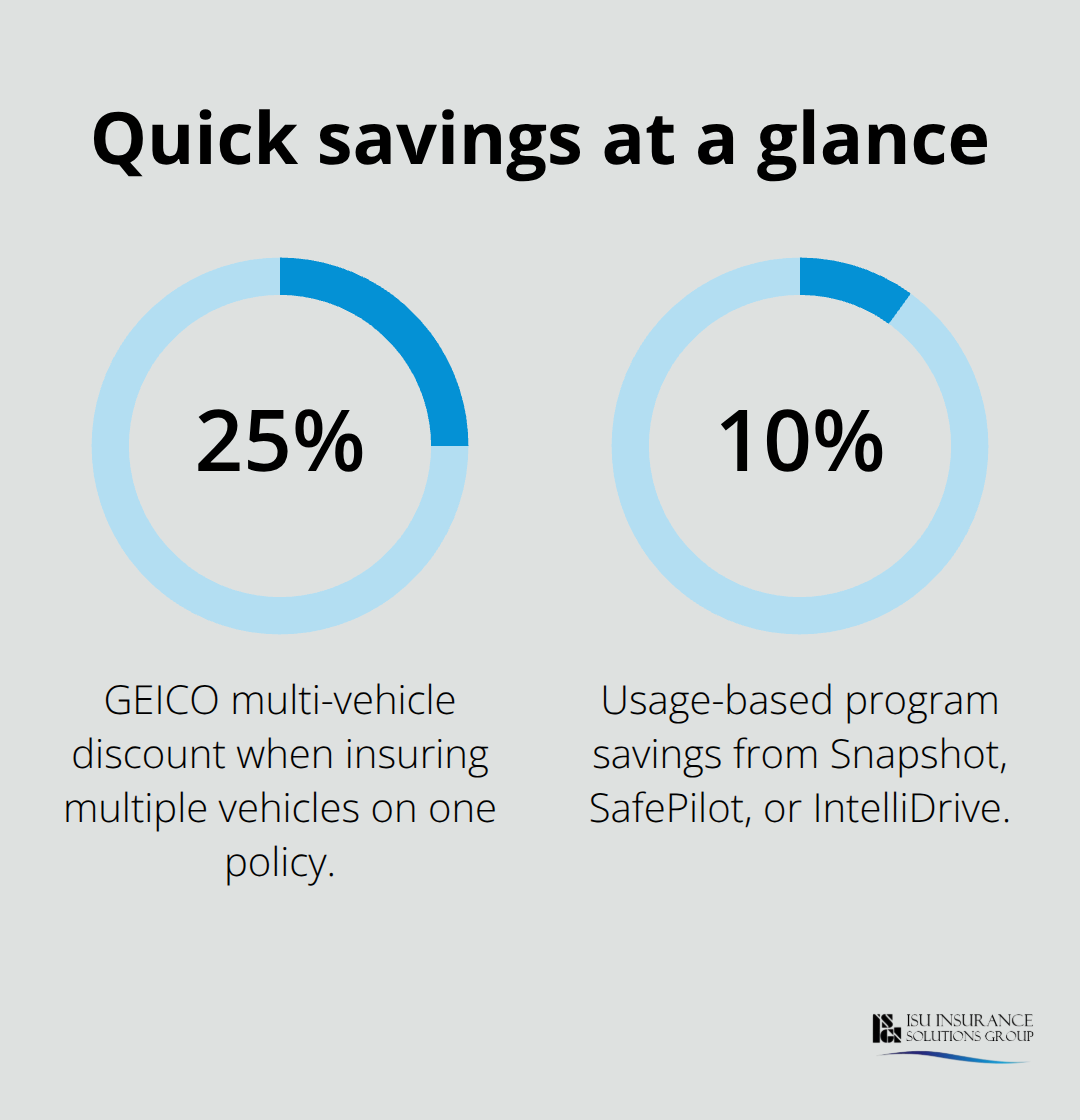
Bundling isn’t a mystery. When you combine auto insurance with another policy-typically home or renters-your carrier applies a multi-policy discount to your total premium. According to Mercury Insurance, bundling saves customers between 10% and 25% on average, though some carriers push higher. Amica offers up to 30% off auto when bundled with home, umbrella, and life insurance. State Farm averages around 25% off car and home combined.

Infographic showing example auto bundle discounts from major carriers

Carriers offer these discounts for a straightforward reason: they want your entire insurance relationship. Managing one customer across multiple lines costs them less than acquiring and servicing separate customers, so they pass savings to you. The discount applies immediately when you add a second eligible policy, with no waiting period. If you currently have auto insurance with one company and home with another, you’re likely leaving money on the table. The gap between what you’re paying now and what a bundle could cost you is real money-potentially $950 per year or more, depending on your location and coverage selections, according to Liberty Mutual’s bundling data.

What Actually Gets Discounted

The discount applies to your total premium, not just one policy. If your auto policy costs $1,200 annually and home costs $1,000, a 20% bundle discount reduces your combined cost from $2,200 to $1,760. This matters because some people mistakenly think the discount applies only to the cheaper policy.

Beyond the percentage discount, bundling prevents coverage gaps that create real problems during claims. When both policies sit with the same carrier, deductibles, liability limits, and endorsements align automatically. During a weather event or accident, you won’t face conflicting interpretations from two different adjusters. One carrier coordinates the entire claim, which streamlines the process significantly. Some carriers sweeten the deal further. USAA, for military families, waives home deductibles for combat-related losses when both auto and home are bundled. Farmers Insurance adds accident forgiveness and rideshare coverage options to bundled policies. These aren’t minor add-ons-they represent genuine protection upgrades that cost extra if purchased separately.

Building Your Bundle Strategy

Start with listing what you actually need to insure. Most people begin with auto and home, but bundling extends to renters, condo, life, umbrella, motorcycle, and boat policies depending on your carrier. Liberty Mutual lets you add any eligible policy to an existing one and immediately receive the multi-policy discount.

Compact list of policy types that can be bundled with auto insurance - auto insurance bundle discounts

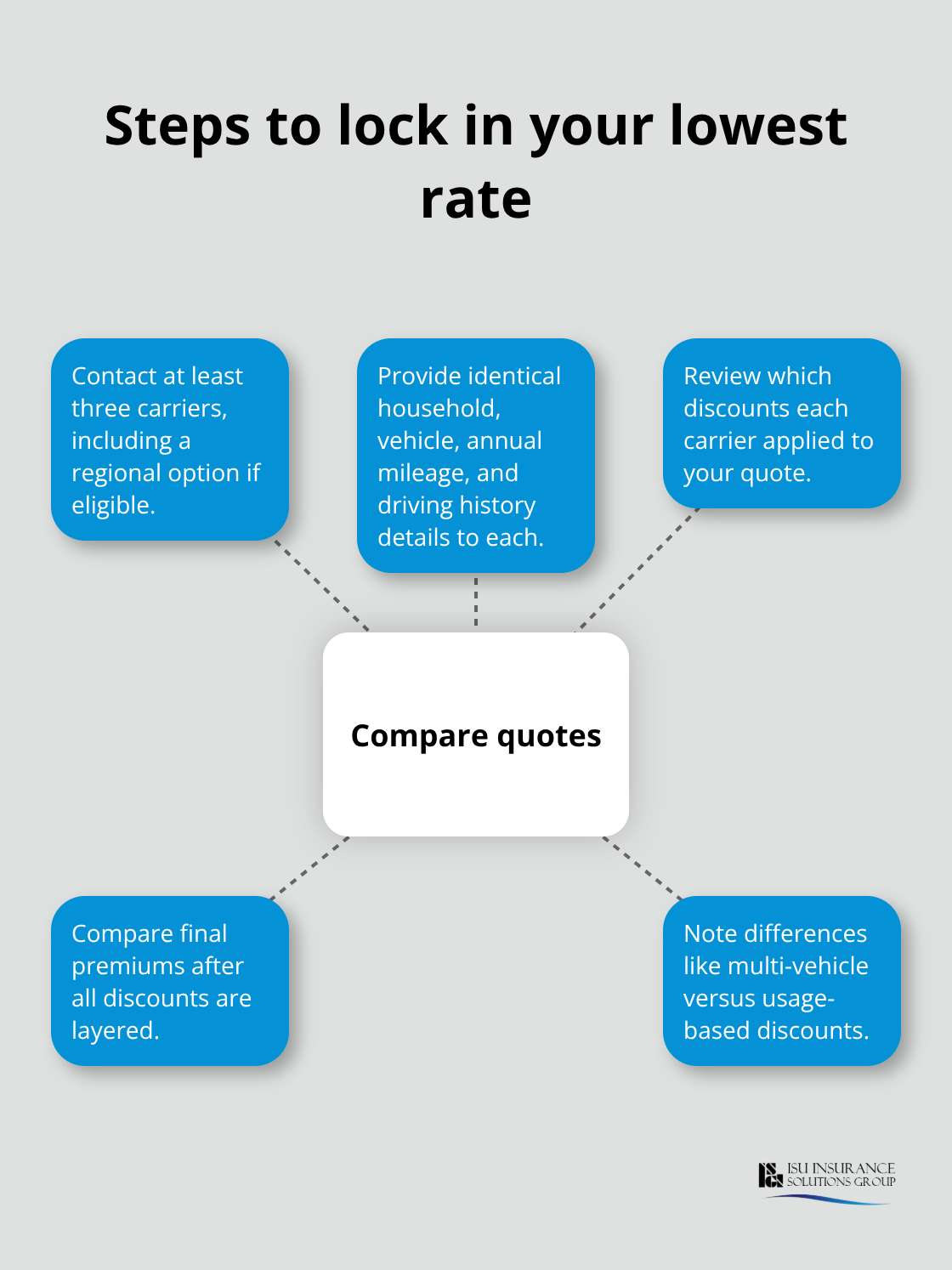
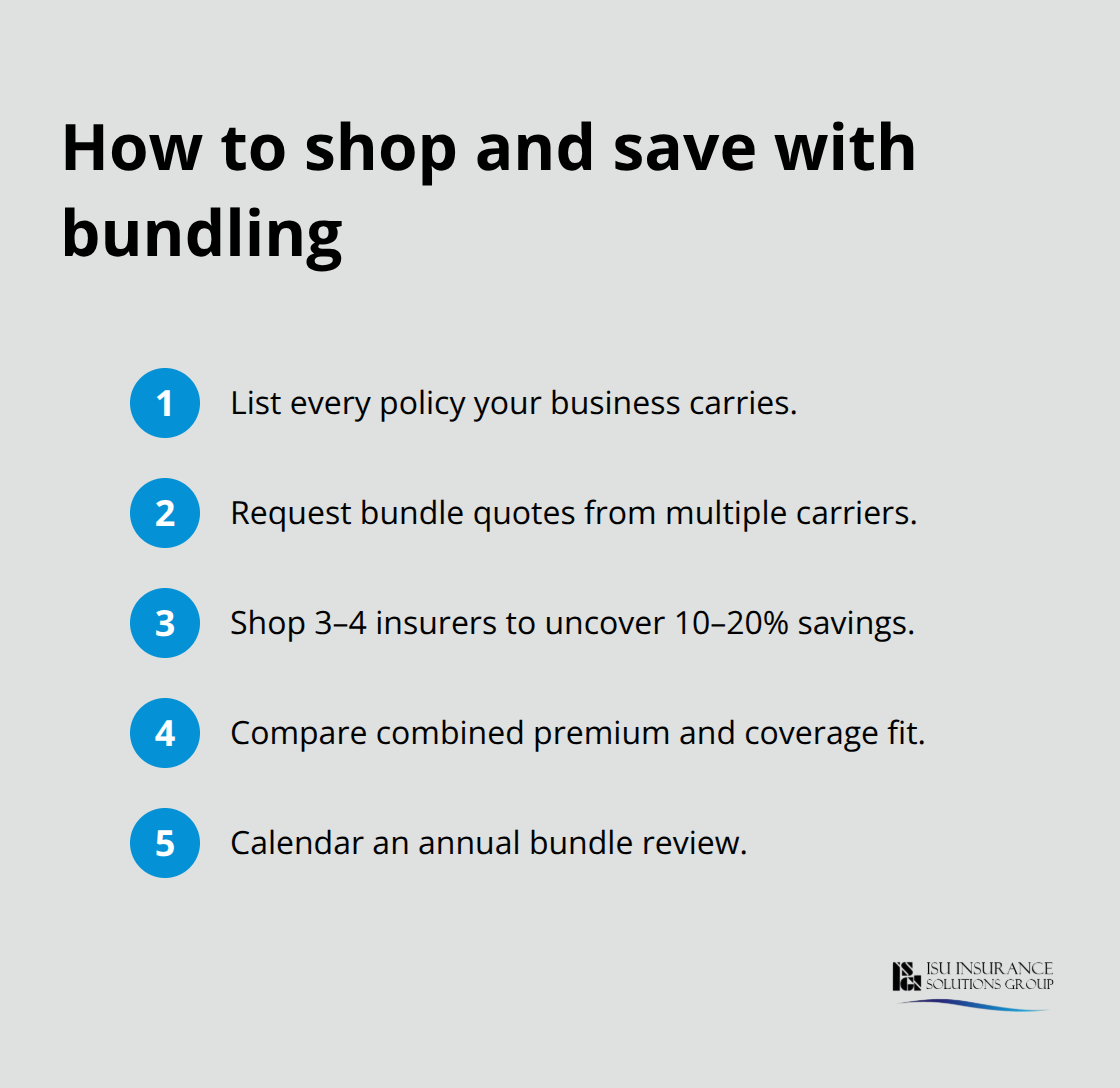
The critical step involves comparing quotes with identical coverage limits and deductibles across carriers. Don’t compare a $500-deductible home policy from one company against a $1,000-deductible policy from another-that’s not an apples-to-apples comparison. Align your policy start and end dates so renewals happen together, preventing gaps in coverage and simplifying your payment schedule. If you currently have separate policies, check when each renews before consolidating. Canceling mid-term triggers pro-rated refunds, but timing matters to avoid any lapse in coverage.

Getting the Right Quotes

An independent agent can pull quotes from multiple carriers simultaneously, saving you hours of phone calls. Not every carrier offers every discount or coverage type, so the cheapest auto option might not be the cheapest when bundled with home. An agent who works with multiple carriers (rather than just one) can show you which bundle actually saves you the most money for your specific situation and location.

Types of Policies You Can Bundle with Auto Insurance

Home and Homeowners Insurance

Home and homeowners insurance represents the most straightforward bundling choice, and for good reason. When you combine auto with homeowners coverage, carriers typically discount both policies. State Farm averages nearly 25% off car and home combined, while Amica pushes higher with up to 30% off when you add umbrella and life insurance to the home-auto foundation. The math works because your home is your largest asset and your car is your second-largest, so carriers view bundling these two as a complete risk picture.

If you rent instead of owning, renters insurance bundles just as effectively with auto. The discount applies identically, and renters policies cost significantly less than homeowners, so your total bundle premium drops faster. Condo owners should verify their carrier covers condo policies in bundle discounts, since some restrict bundling to traditional homeowners policies.

The practical advantage of bundling home or renters with auto goes beyond the percentage discount. Your renewal dates align, your deductibles coordinate, and claims involving both policies move faster because one adjuster handles everything rather than two carriers playing phone tag during a stressful situation.

Life Insurance and Umbrella Coverage

Life insurance and umbrella coverage take bundling further. Amica specifically offers substantial savings when you add life and umbrella to an auto-home bundle, recognizing that customers protecting their families comprehensively deserve meaningful discounts. Umbrella policies sit above your auto and home coverage, protecting you when liability claims exceed those underlying limits.

Most people underestimate how quickly a serious accident can exceed standard liability limits, so umbrella coverage matters more than it appears. When bundled, the umbrella discount stacks with your auto-home savings, and the carrier ensures your umbrella limits align perfectly with your underlying coverage.

Commercial Auto for Business Vehicle Owners

Business insurance for vehicle owners operates differently. If you use your vehicle for business purposes-rideshare, delivery, contractor work-standard personal auto policies exclude those uses entirely. Commercial auto insurance becomes necessary, and bundling commercial auto with your personal home policy still qualifies for multi-policy discounts at many carriers.

Farmers Insurance, for example, provides up to 10% off on each policy when bundling, making commercial auto bundling viable for self-employed individuals and small business owners who previously thought bundling wasn’t an option. The key is disclosing business use upfront. Failing to do so voids your coverage, leaving you uninsured during the activity that matters most.

An independent agent can help you identify which policies qualify for bundling at your carrier and whether commercial auto bundling makes financial sense for your situation. The next step involves comparing quotes across multiple carriers to see which bundle actually delivers the greatest savings for your specific coverage needs and location.

How to Actually Compare Bundle Quotes

Match Every Coverage Detail

Comparing bundle quotes across carriers fails when you pick the cheapest option without verifying that you’re comparing identical coverage. One quote might include a $500 home deductible while another uses $1,000. One auto policy might have $100,000 liability limits while another has $300,000. These aren’t the same products, and a $200-per-year savings on a policy with half the coverage isn’t actually savings-it’s a trap.

When you compare, match every coverage detail: deductible amounts, liability limits, comprehensive and collision coverage, endorsements, and any add-ons. This apples-to-apples approach takes more time upfront but prevents costly mistakes later.

Checklist of coverage items to align across bundle quotes - auto insurance bundle discounts

Work with an Independent Agent for Multi-Carrier Quotes

The most efficient approach involves using an independent agent who works with multiple carriers simultaneously. Instead of spending three hours calling different companies, an agent pulls quotes from 10+ carriers in one session with identical coverage specifications. This matters because some carriers excel at auto rates while others dominate home pricing. State Farm might beat everyone on combined auto-home pricing, but Amica could offer better umbrella discounts when you add that third policy.

An independent agent shows you which combination actually saves the most money for your specific situation and location, not just which single policy is cheapest. A local agent can compare policies from multiple carriers to deliver personalized quotes that fit your actual needs and budget.

Coordinate Your Policy Renewal Dates

Timing your bundling decision requires strategic thinking about policy renewal dates. If your auto renews in March and home renews in August, bundling creates a coordination problem. You pay two separate premiums on two schedules, and you miss the benefit of aligned renewals.

Before switching carriers, check when each current policy renews. If you’re bundling policies currently with different companies, coordinate the start dates so both renew together going forward. This prevents coverage gaps when you cancel one policy before the other begins. Some carriers allow you to start a new policy mid-month to align renewal dates, which costs a few extra dollars in pro-rated premiums but eliminates months of administrative friction.

Conduct Annual Coverage Reviews

After bundling, review your coverage annually during renewal to confirm you still have adequate protection. Life changes-you buy a second vehicle, your home value increases, you purchase expensive equipment for work. Your bundle discount stays locked in, but your coverage needs may have shifted.

An independent agent can conduct a policy review in 20 minutes, identify gaps, and suggest adjustments without pressure to switch carriers. This annual check prevents the costly mistake of keeping outdated coverage just because you bundled years ago.

Final Thoughts

Auto insurance bundle discounts typically save you between 15% and 25% annually, though some carriers push higher with options reaching 30% when you add umbrella and life insurance. That translates to real money in your pocket-potentially $950 per year or more depending on your location and coverage selections. Beyond the percentage discount, bundling eliminates coverage gaps, aligns your deductibles and liability limits, and streamlines claims handling when accidents happen.

The right auto insurance bundle discounts depend entirely on your specific situation. Your carrier matters, your location matters, and which policies you actually need matters. State Farm averages around 25% off combined auto and home, while Amica reaches up to 30% when you add umbrella and life insurance to your bundle. Farmers Insurance provides up to 10% off each policy when bundling, and these aren’t theoretical numbers-they represent what real customers save when they consolidate their coverage strategically.

An independent agent accelerates this process significantly by pulling quotes from 10+ carriers simultaneously with identical coverage specifications. Rather than calling multiple companies yourself, an agent reveals which combination actually works best for your situation and location. Contact ISU Insurance Solutions Group to explore your bundle options and find the coverage combination that protects your family while lowering your total premium.

The information provided in this blog is for general informational purposes only and does not constitute legal, financial, or insurance advice. Coverage options, terms, and availability may vary. Please consult with a licensed professional for advice specific to your situation.
Brewery Bonds and Insurance: Meeting Bond Requirements and Protecting Growth

Running a brewery means navigating a complex web of federal permits, state regulations, and insurance requirements. Brewery bonds and insurance aren’t optional extras-they’re foundational to legal operation and financial stability.

At ISU Insurance Solutions Group, we’ve helped dozens of breweries understand what coverage they actually need versus what’s just noise. This guide walks you through the bonds required by law, the insurance that protects your operation, and how to identify gaps before they cost you.

Federal and State Brewery Bond Requirements

What Federal Regulations Require

The federal government requires breweries to post a Brewer’s Bond if their beer tax liability under a single EIN exceeds $50,000 in a calendar year-either this year or last year. This threshold comes from the PATH Act of 2015 and is enforced by the Alcohol and Tobacco Tax and Trade Bureau (TTB). The bond itself guarantees payment of federal excise taxes, penalties, and interest, acting as security for your tax obligations. If your liability stays under $50,000, you avoid federal bonding requirements, but you still need a TTB Brewer’s Notice to operate legally.

The TTB requires two bond forms depending on your situation: Form 5130.22 for a standard Brewer’s Bond or Form 5130.25 for a Brewer’s Collateral Bond. Minimum federal bond amounts are $1,000 for breweries and $500 for pilot brewing plants, though larger operations need significantly higher coverage. Bond terms last four years and can be renewed with a continuation certificate.

Federal Bond Costs and Timeline

Pricing typically runs about $12 per $1,000 of coverage for the first $25,000, $8 per $1,000 for the next $25,000, and $3.75 per $1,000 for amounts above $50,000 up to $400,000. You can purchase federal bonds instantly online for coverage up to $50,000. The TTB National Revenue Center at 877-882-3277 provides guidance on exact amounts and bond documentation.

State Bonds Add Substantial Costs

Most states require additional bonds separate from federal requirements. In Texas, for example, the TABC requires a Conduct Surety Bond ranging from $5,000 to $10,000 depending on your distance from a public school-a factor many breweries overlook during site selection. If you operate an alternating proprietorship or contract brewing arrangement, you’ll need a Fee Interest Bond of $30,000.

Quick facts on common state brewery bond requirements and instruments. - Brewery bonds and insurance

Washington and Oregon have their own licensing frameworks, and bonds can be satisfied as a traditional surety bond, a letter of credit, or an assignment of a certificate of deposit.

Common Submission Mistakes

The critical mistake breweries make is underestimating state bond costs during their financial planning phase. These bonds protect regulators and the public, not your business, so they’re non-negotiable for licensure. Processing delays happen when bonds aren’t submitted through the right channel-many states now require digital submission through their licensing systems rather than paper forms, which can add weeks to your permit timeline. Understanding your state’s specific submission requirements upfront prevents costly delays as you move toward opening.

What Insurance Do Breweries Actually Need

Coverage That Protects Beyond Legal Requirements

Federal bonds and state licensing requirements keep your brewery legal, but insurance protects your business from the financial devastation that bonds don’t cover. A U.S. food and beverage recall rose 11 percent in 2023 according to PR Newswire, and a single product recall can cost a microbrewery between $50,000 and $500,000 depending on distribution scope and contamination severity. Property coverage protects your fermentation tanks, brewing equipment, and facility against fire, weather damage, and theft-but standard commercial policies often exclude brewery-specific risks like yeast contamination, leakage from fermentation vessels, and the extra costs of keeping fermentation systems running after equipment failure.

Percentage increase in U.S. food and beverage recalls in 2023. - Brewery bonds and insurance

You need coverage that includes specialized equipment endorsements, spoilage protection, and business income loss if your production shuts down for weeks.

Liability Coverage for Tours, Tastings, and Distribution

General liability and liquor liability work together to cover bodily injury or property damage claims from brewery tours, tastings, and off-site consumption at bars and restaurants. A single slip-and-fall during a tour or an alcohol-related incident at an event can trigger lawsuits exceeding $100,000 in legal defense alone. Workers compensation is mandatory in every state and covers medical care and wage replacement when your brewing staff gets injured-but brewery environments carry elevated slip-and-fall risks from wet floors, equipment operation, and heavy lifting.

Product Recall and Manufacturing Risk Protection

Product liability coverage specifically covers the costs of removing contaminated or mislabeled beer from shelves, notifying distributors and retailers, and replacing inventory. Without this coverage, a recall eats directly into your cash reserves and can force operational cutbacks. Manufacturers errors and omissions insurance fills gaps that general and product liability policies miss, protecting against manufacturing defects, formula changes, or labeling errors that cause customer harm. As your brewery scales production and distribution, umbrella or excess liability coverage becomes essential-it extends protection above your primary policy limits when a major incident occurs.

Calculating Your Coverage Investment

Microbreweries typically spend $500 to $1,500 monthly on comprehensive coverage depending on facility size, production volume, and distribution range. A risk assessment identifies your specific exposure: what equipment could fail, where customers visit your facility, how far your products travel, and what contamination scenarios keep you awake at night. That assessment drives your coverage choices far better than a generic package, and it positions your brewery to scale without coverage gaps that emerge only after growth happens. Understanding your actual risk profile also matters when you move toward expansion-growth introduces new liability exposures and property values that your current policies may not address.

Protecting Your Brewery Before Growth Happens

Expansion exposes gaps you didn’t know existed. A brewery operating at 5,000 barrels annually faces different property, liability, and supply chain risks than one scaling to 15,000 barrels. The insurance that protects your current operation often falls short when you add production lines, hire more staff, expand distribution territory, or open a taproom. A formal risk assessment before any major growth move identifies specific exposures that your existing policies don’t address.

Equipment and Facility Risk

Your fermentation tanks, chillers, grain mills, and packaging equipment represent your largest asset base, yet standard commercial property policies exclude brewery-specific losses. Equipment failure during fermentation destroys batch inventory, forces production shutdowns, and creates extra costs to restart fermentation systems. As you scale, your equipment value climbs, and your dependency on continuous operation intensifies. A risk assessment quantifies your actual replacement costs for specialized brewing equipment and determines whether your current property coverage includes spoilage protection, equipment breakdown endorsements, and business income coverage for lost production days. Many breweries discover their policies cap spoilage losses at $10,000 when a single contaminated batch costs $50,000 to replace. Growth amplifies this gap. If you expand production capacity, your insurer needs updated equipment schedules and facility diagrams before claims happen. Waiting until after a loss to discover coverage shortfalls proves expensive.

Liability Exposure and Distribution Changes

Adding a taproom, expanding to new states, or hiring delivery drivers introduces liability scenarios your current general and liquor liability policies may not fully address. A delivery vehicle accident in a new state can trigger workers compensation and auto liability claims outside your current coverage territory. Hiring seasonal staff during peak production means more people work around fermentation vessels, pressurized tanks, and heavy equipment-environments with genuine slip-and-fall and equipment-related injury risk. Your workers compensation coverage must reflect your actual payroll and the physical demands of brewery work. Umbrella liability becomes essential once your distribution reaches multiple states or once your taproom draws significant foot traffic. A single serious injury claim can exceed your primary liability limits quickly. Growth also increases product liability exposure. Distributing to 20 bars across two states multiplies the scenarios where contamination, labeling errors, or allergenic ingredients trigger recalls or injuries. Product recall coverage becomes non-negotiable at this scale. Breweries face genuine contamination risks, and product recall coverage protects against the financial impact of recalls and injuries.

Supply Chain Vulnerabilities and Coverage Gaps

Scaling production depends on reliable suppliers-grain sources, yeast cultures, packaging materials, and equipment maintenance. A disruption in any of these areas can halt production for weeks. Inland marine coverage protects your beer and ingredients while in transit from suppliers or to distributors, covering loss from theft, weather, or vehicle damage. Ocean marine coverage applies if you ship products across water. These aren’t standard coverages; they require specific endorsements tailored to your supply chain routes and product values. Your risk assessment should identify your critical suppliers and the financial impact if they become unavailable. If a single grain supplier provides 70 percent of your malt, what happens to production if that supplier’s facility burns down? That scenario is rare but catastrophic.

Hub-and-spoke view of key growth risks for breweries and matching insurance focus areas.

Contingency planning and appropriate coverage matter more as your operation becomes more complex. Your assessment also reveals whether cyber insurance makes sense. As breweries adopt digital systems for inventory management, recipe tracking, and distribution logistics, data breaches and malware attacks become real operational threats. A ransomware attack on your production scheduling system can force manual operations and production delays.

Final Thoughts

Brewery bonds and insurance form the backbone of a sustainable operation. Federal bonds keep you compliant with the TTB, state bonds satisfy licensing requirements, and comprehensive insurance protects the assets and revenue that bonds don’t cover. Most breweries treat these as separate concerns rather than interconnected safeguards that work together to support growth.

Your current coverage likely has gaps you haven’t discovered yet. A formal risk assessment identifies what your policies actually protect and where exposure exists. That assessment should examine your equipment replacement costs, your liability scenarios across all customer touchpoints, your supply chain dependencies, and the financial impact of production shutdowns or recalls. Growth amplifies every gap, and your insurance must evolve with your operation.

We at ISU Insurance Solutions Group work with breweries across Washington and Oregon to build coverage that matches their operations. Our agents understand brewery-specific risks, from fermentation equipment to distribution logistics, and we quote across multiple carriers to find competitive rates without coverage gaps. If you’re uncertain whether your current policies protect your growth plans, contact our team to discuss your brewery’s coverage needs.

The information provided in this blog is for general informational purposes only and does not constitute legal, financial, or insurance advice. Coverage options, terms, and availability may vary. Please consult with a licensed professional for advice specific to your situation.
Fleet Auto Insurance: Eight Ways to Protect Your Vehicle Fleet

Fleet auto insurance protects your business, but only if you have the right strategy in place. Most fleet managers focus solely on finding cheap premiums and miss the bigger picture of risk management.

At ISU Insurance Solutions Group, we’ve seen firsthand how companies that combine strong safety practices with solid coverage avoid costly accidents and claims. This guide walks you through eight concrete steps to strengthen your fleet’s protection.

1. Build a Driver Safety Program That Actually Works

A comprehensive driver safety program isn’t about creating a binder of policies that nobody reads. It’s about establishing measurable expectations and holding drivers accountable. Write safety guidelines that cover specific behaviors: speed limits on different road types, following distance requirements, phone use restrictions, and how to handle adverse weather. These aren’t suggestions-they’re non-negotiables that every driver signs off on. Defensive driving training offers measurable returns that directly impact your bottom line.

Annual Motor Vehicle Record reviews catch violations early, and responding immediately to infractions prevents repeat offenses. Drivers who know their records are monitored change their behavior. Incentive programs work because they reward the behavior you want to see-offer bonuses, gift cards, or extra time off for drivers who complete a full year without accidents or violations. This approach shifts the culture from compliance-only to safety-first. High-risk drivers identified through violations or near-misses need targeted retraining on defensive techniques and vehicle-specific operations rather than generic safety lectures.

When you combine clear policies, regular training, consistent monitoring, and positive reinforcement, you create an environment where safe driving becomes the norm. This foundation makes everything else in your fleet protection strategy more effective. The next step involves adding technology that tracks driver behavior in real time and identifies patterns before they cause accidents.

2. Install Telematics and GPS Tracking Systems

Telematics technology transforms fleet management from reactive to proactive by capturing real-time data on driver behavior, vehicle performance, and operational efficiency. Systems that monitor speeding, harsh braking, rapid acceleration, and idling patterns give you actionable insights into which drivers need coaching and which routes generate the most risk. Real-time GPS tracking and in-cab alerts prevent accidents by providing immediate feedback to drivers when they exceed safe thresholds. When you share this data with insurance carriers that offer usage-based discounts, you move beyond standard commercial auto rates and access pricing tied to actual performance rather than industry averages. Fleets that implement telematics typically see 45% fewer accidents, 75% fewer speeding events, and 80% reduction in aggressive driving within the first year.

Chart showing safety improvements after telematics adoption: fewer accidents, fewer speeding events, and reduced aggressive driving. - Fleet auto insurance

Beyond safety, telematics delivers measurable cost reductions that justify the investment immediately. Idle-time monitoring eliminates unnecessary fuel waste and has saved fleets up to $3 million annually, while route optimization and fuel analytics reduce overall spend by identifying inefficient patterns and driver habits. Real-time vehicle diagnostics catch mechanical problems before they cause breakdowns, preventing costly repairs and reducing liability exposure from equipment failure. Documented case studies show $2.5 million in fuel savings, $1.1 million in maintenance cost reductions, and 23% improvement in vehicle utilization across customer fleets. The IDC study documents 8 times return on investment, meaning a $50,000 telematics deployment across a mid-sized fleet typically recovers costs within months and continues generating savings through reduced claims and operational efficiency.

With visibility into driver behavior and vehicle performance, you now need to protect that investment through consistent maintenance. The next step focuses on establishing a regular vehicle maintenance schedule that prevents breakdowns and catches safety issues before they escalate into claims.

3. Maintain a Maintenance Schedule That Prevents Claims

Preventive maintenance separates fleets that run smoothly from those that generate expensive insurance claims. Most fleet managers wait until something breaks, but that approach costs thousands in emergency repairs, downtime, and accident liability. Create a maintenance schedule tied directly to manufacturer recommendations and vehicle mileage intervals, then execute it without exception. Document every oil change, tire rotation, brake inspection, and fluid check in a centralized system so you have proof of compliance when an insurer reviews your risk management practices. Detailed service records signal to insurers that you take fleet protection seriously and often result in better rates or faster claims processing.

Safety recalls demand immediate action because ignoring them creates coverage gaps that can deny claims. If a vehicle fails due to a known defect that you neglected to address, your insurer may refuse to cover the resulting accident or injury claim. Check the National Highway Traffic Safety Administration website monthly for recalls affecting your vehicles and complete repairs within 30 days. Catching mechanical problems early through regular inspections prevents breakdowns that lead to accidents on the road. A transmission that slips slightly during routine maintenance is a minor repair; that same transmission failing at highway speed becomes a catastrophic collision with potential fatalities and six-figure liability exposure.

With your vehicles properly maintained and your drivers trained, the next critical step involves defining clear policies about who drives your fleet and under what circumstances they operate company vehicles.

4. Set Clear Vehicle Use and Assignment Policies

Vague vehicle policies create liability gaps that insurance companies exploit when claims arise. Define exactly who can operate company vehicles-not just job title, but specific names and driver qualifications-and document that authorization in writing. Establish non-negotiable rules about personal use, passenger policies, after-hours operation, and geographic boundaries that drivers cannot exceed. A driver using a company truck to move personal furniture on weekends or transporting unauthorized passengers creates exposure your insurer may refuse to cover if an accident occurs. Geographic restrictions matter because a regional delivery fleet operating within 50 miles of your base has fundamentally different risk than vehicles traveling across state lines, and your coverage must align with actual usage patterns.

Require drivers to report every accident and incident immediately, regardless of perceived severity. A minor fender-bender that goes unreported for weeks damages your credibility with insurers and complicates claims investigation when damage worsens or injuries surface later. Assign specific vehicles to individual drivers whenever possible because accountability eliminates the finger-pointing that delays incident response and claims resolution. When Driver A knows he operates Vehicle 5 every shift, he takes ownership of pre-trip inspections, maintenance needs, and safe operation in ways that shared vehicle fleets never achieve. Document all assignments in a simple spreadsheet that tracks which driver operated which vehicle on which dates-this becomes critical evidence if disputes arise about who caused damage or liability.

Clear, accessible policies reduce liability and boost accountability across departments. Your insurer can defend claims more effectively and you can demonstrate the risk controls that qualify for better rates. The next step involves screening the people who operate your vehicles before they ever get behind the wheel.

5. Screen Drivers Before and After You Hire Them

Most fleet accidents involve drivers with prior violations or suspended licenses that should have disqualified them from the job. Before hiring anyone to operate company vehicles, pull a comprehensive driving record check through the Department of Licensing to verify license validity, accident history, and outstanding violations. Your insurance policy sets minimum age and experience requirements-typically 21 years old with at least two years of driving history-and hiring drivers below those thresholds voids coverage on claims. Drug and alcohol testing during the hiring process isn’t optional if you want insurers to take your risk management seriously; random testing throughout employment catches substance abuse issues before they cause catastrophic accidents. A single DUI or reckless driving conviction increases accident likelihood dramatically, and documenting your screening process proves to insurers that you exercise reasonable care in driver selection.

Screen drivers before and after you hire them to reduce risks related to accidents and liability. Re-screen all drivers annually or whenever your insurance policy renews to catch license suspensions, new violations, or conviction records that emerged after employment began. A driver with a clean record at hire might accumulate three speeding tickets and a suspended license within 12 months, and failing to catch that creates massive liability exposure. Set a specific date each year-perhaps tied to your insurance renewal-and run fresh records on every driver in your fleet without exception. Drivers who accumulate violations should face retraining, reassignment to non-driving roles, or termination depending on severity. This systematic approach demonstrates to your insurer that you maintain active oversight of driver qualifications, which directly supports your case for competitive rates and faster claims processing. With your drivers properly vetted and monitored, the next step involves selecting coverage levels and policy structures that actually protect your fleet when accidents happen.

6. Select Coverage That Matches Your Fleet’s Actual Risk

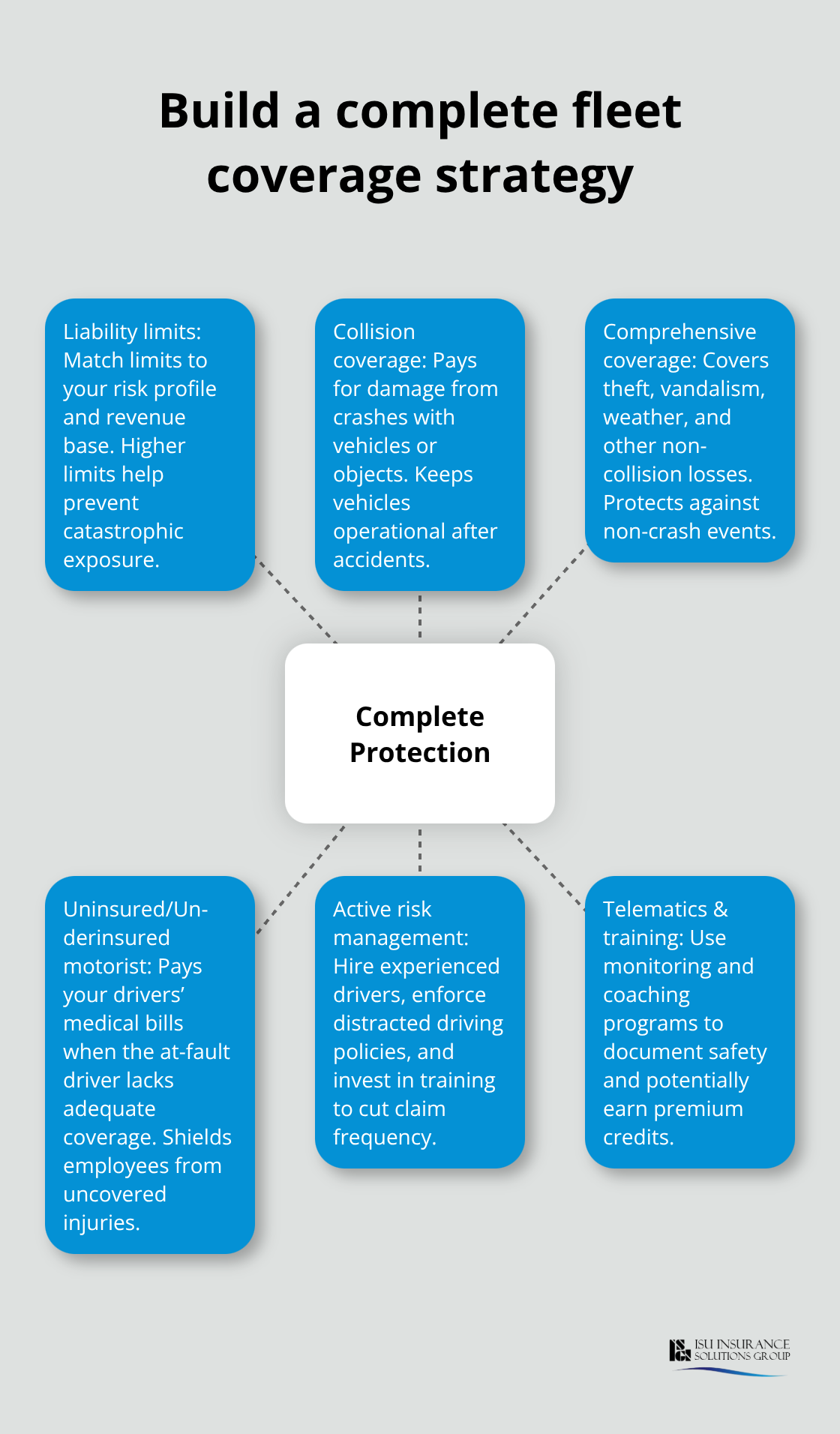
State minimum liability limits exist as legal baselines, not as adequate protection for fleet operations. Most states require $15,000 to $25,000 in bodily injury liability per person, but a single serious accident involving multiple injured parties generates $200,000 to $500,000 in medical costs, lost wages, and pain-and-suffering claims that exceed those minimums by tenfold. Regional fleets should carry liability limits of at least $100,000 per person and $300,000 per accident, while vehicles traveling across state lines or operating in high-density urban areas need $250,000 per person and $500,000 per accident. The additional premium for higher limits costs roughly $400 to $800 annually per vehicle but protects your company from catastrophic judgments that force bankruptcy. Comprehensive and collision coverage becomes essential for vehicles newer than five years old, where replacement cost justifies the protection; for older units with market values under $5,000, raising deductibles to $1,000 or $2,500 reduces premiums while keeping coverage intact for major losses.

Uninsured and underinsured motorist coverage addresses the reality that approximately 13% of drivers nationwide carry no insurance, and many carry limits far below what they actually owe after causing serious injury. This coverage pays your claims when an at-fault driver cannot, preventing your fleet from absorbing losses caused by someone else’s negligence. If your drivers operate personal vehicles for work purposes (making client visits, attending meetings, or running errands), hired and non-owned auto coverage becomes mandatory because your commercial policy excludes those vehicles unless explicitly added.

Hub-and-spoke diagram showing key coverage elements for fleets.

Review your actual fleet operations annually to identify coverage gaps: new vehicles added, expanded geographic territory, or increased employee use of personal vehicles all demand policy adjustments before accidents expose those gaps. With your coverage structure locked in place, the next step involves creating a detailed accident response protocol that minimizes damage and protects your company when incidents occur.

7. Create an Accident Response Protocol That Protects Your Fleet

Accidents happen regardless of prevention efforts, but how your fleet responds determines whether claims get paid quickly or become disputed nightmares that drag on for months. Equip every driver with a laminated accident instruction card listing the exact steps to take at the scene: turn on hazard lights, move vehicles to a safe location if possible, call 911 for injuries, exchange information with other parties, and photograph everything before anyone moves vehicles. The card should include your direct reporting hotline number and your insurer’s claims hotline so drivers know exactly who to call without guessing or delays. Photographs must capture vehicle damage from multiple angles, road conditions, traffic signals, weather, and the other party’s vehicle and license plate.

Compact checklist of immediate steps drivers should take after an accident. - Fleet auto insurance

Drivers who document scenes thoroughly give adjusters and defense attorneys clear evidence to support your claim, while poor documentation creates gaps that opposing counsel exploits to deny liability or reduce your recovery.

Require drivers to file reports within two hours of an accident, not the next day or whenever they remember-time delays allow witnesses to disappear and memories to fade. Review every accident within 48 hours to identify root causes and determine whether additional driver training or policy changes could prevent similar incidents. A driver rear-ending another vehicle at a traffic light signals need for defensive driving training focused on following distance and anticipating stops. A vehicle leaving the roadway on a curve at night suggests the driver was speeding or distracted, requiring targeted retraining or reassignment to lower-risk routes. Track patterns across your entire fleet: if three drivers have accidents during rain within a six-month period, implement inclement weather training for all operators. Document your accident reviews in writing and share findings with your insurer because demonstrating continuous improvement strengthens your case for competitive renewal rates. This systematic approach transforms accidents from isolated incidents into learning opportunities that strengthen your entire fleet’s safety culture and position you to work with an independent agent who specializes in commercial fleet coverage.

8. Partner with an Independent Agent Who Understands Fleet Operations

Most fleet managers shop for insurance the way they buy gas-finding the cheapest price and moving on. That approach costs thousands annually in missed discounts, inadequate coverage, and claims that get denied because policies don’t match actual operations. An independent agent with commercial fleet expertise accesses multiple carriers simultaneously and runs quotes from insurers that specialize in your specific industry, whether that’s construction, delivery, service calls, or regional transportation. Carriers that focus on fleet operations understand nuances that generalist insurers miss: they know how telematics investments lower claims, they recognize the value of formal driver training programs, and they reward documented safety practices with tangible premium reductions. A good agent compares not just price but coverage structures, deductibles, and policy limits across five to eight carriers, identifying which combination actually protects your fleet instead of creating gaps when accidents happen.

An independent agent serves as your advocate during claims disputes and policy reviews. When a driver causes a serious accident, your agent manages communication between your company, the insurer, and legal counsel to protect your interests and accelerate resolution. As your fleet grows-new vehicles added, operations expanded, or service territories changed-your agent adjusts coverage proactively rather than discovering gaps after incidents occur. They can manage multiple policies through multiple carriers for you, so you can get the best prices for the right coverage. Having a single point of contact who knows your fleet, your drivers, and your coverage eliminates the frustration of juggling multiple insurers and ensures consistency across renewals and claims, positioning you to implement the final protective layer that ties everything together.

Final Thoughts

The eight strategies outlined in this guide work together to create a comprehensive fleet auto insurance protection system that reduces accidents, lowers premiums, and keeps your drivers safe. Strong risk management practices alone won’t protect you if your coverage has gaps, and comprehensive coverage alone won’t prevent accidents if your drivers lack training and accountability. Fleet auto insurance delivers maximum value when you combine documented safety programs, technology investments, maintenance discipline, and policy structures that match your actual operations.

Lower accident frequency directly decreases claims and renewal premiums, while documented safety practices qualify you for carrier discounts ranging from 10% to 25% depending on your telematics data and driver training investments. Fewer breakdowns mean less downtime and reduced liability exposure from equipment failures. When you implement these eight steps systematically, your total cost of fleet operations drops significantly while your protection strengthens.

We at ISU Insurance Solutions Group have served Washington and Oregon businesses since 1983, building deep expertise in Pacific Northwest fleet operations across construction, delivery, service, and transportation sectors. Our independent agency accesses 20+ carriers simultaneously, comparing coverage and pricing to find solutions tailored to your specific fleet and regional exposure. Contact us now to review your current fleet auto insurance and identify which strategies need attention before the next accident exposes coverage gaps.

The information provided in this blog is for general informational purposes only and does not constitute legal, financial, or insurance advice. Coverage options, terms, and availability may vary. Please consult with a licensed professional for advice specific to your situation.